Reactivate Your Talent Pool: Win Back Dormant Candidates with Messaging
SendSeven Team, Editorial Team
Thousands of candidates in your ATS, but no channel that reaches them. Email newsletters get 20–25% open rate. WhatsApp broadcasts get 98%. This article shows how to reactivate your talent pool via GDPR-compliant multichannel messaging.
TL;DR
Thousands of candidates in your ATS — but no channel that reaches them. A newsletter gets 20–25% open rate. A WhatsApp broadcast would get 98%. This article shows how to reactivate your talent pool via GDPR-compliant multichannel messaging: WhatsApp broadcasts, email nurture, Instagram Story teasers, and browser push notifications for new roles. Back to the overview: Recruiting Messaging Guide 2026.
The sleeping talent pool: wasted capital
Most organisations have built up a substantial talent pool over the years — in their ATS, in spreadsheets, or in a recruiter's inbox. These are people who applied for a role, went through an interview, maybe made it to the final round, but were not placed. They were interested once. They know your company. The activation cost for them is a fraction of new acquisition.
And yet: in most organisations, these candidates are never contacted again. Not because there are no suitable new roles — but because there is no process, no tool, and no channel that makes reactivation feel viable.
The numbers are stark: according to industry data, the average cost per hire is EUR 4,500–9,000 (including employer branding, job boards, recruiter time). Reactivating a talent pool candidate costs EUR 50–200, depending on the segment and the messaging effort. The ROI difference is 20:1 to 90:1.
Opt-in strategies: GDPR-compliant reactivation
Before the first WhatsApp message, you need a valid legal basis. For former applicants who have not been in contact for more than 6 months, this means: explicit re-consent.
Three proven opt-in strategies for talent pool reactivation:
1. Opt-in at the time of rejection
The most powerful moment: when you send the rejection email, include an opt-in option for your talent pool. "We don't have a match right now — but we'd love to keep in touch. Click here to join our talent pool and be the first to hear about relevant opportunities." Candidates in this moment are emotionally invested and the opt-in rate is typically 30–50%.
2. Re-consent campaign via email
For existing ATS contacts without a documented WhatsApp opt-in: send a targeted email asking for opt-in for WhatsApp communication. Subject: "We have a new role that matches your profile — can we send you details via WhatsApp?" The email is the bridge; WhatsApp is the ongoing channel.
3. Opt-in via careers page widget
A persistent opt-in widget on your careers page ("Join our talent pool — get notified of relevant roles first") captures passive candidates who visit your site without applying. SendSeven's live chat and newsletter widgets support this flow natively.
All opt-ins are documented with timestamp and source in SendSeven — full GDPR audit trail included.
Segmentation: who to contact when
Mass broadcasting your entire ATS is the fastest way to generate opt-outs. The key to effective talent pool reactivation is segmentation. Relevant message to the right person at the right time.
The most important segmentation dimensions:
| Dimension | Segments | Why it matters |
|---|---|---|
| Skills / role type | Tech, marketing, sales, ops, etc. | Ensures message-role relevance |
| Last contact date | < 6 months, 6–12 months, 12–24 months, 2+ years | Determines required opt-in level |
| Process stage reached | Applied, phone screen, first interview, final round | Indicates qualification level and prior engagement |
| Location | City, region, remote-ready | Ensures geographic fit |
| Opt-out status | Active opt-in, pending, opted out | Legal compliance |
SendSeven's contact management lets you create custom tags and filters. You can define a segment directly from your ATS export and start a campaign in minutes.
Campaign templates for talent pool reactivation
Three campaign types that deliver consistent results:
Campaign 1: "We have a new role that matches your profile"
The most direct reactivation message. Personalised to the candidate's profile, specific role information, low-friction CTA (reply "Interested" or "Not right now"). Response rate: 15–35% depending on segment and recency.
Campaign 2: "Our company has grown — new opportunities"
For candidates from 12+ months ago. Acknowledges time has passed, highlights company growth and new openings broadly, invites to updated application. Creates FOMO through growth narrative.
Campaign 3: The win-back campaign
For candidates who went quiet after a final round rejection. Personal message from a named recruiter, acknowledges the past process, references specific skills that are now in demand. Highest emotional resonance, highest response rate (up to 40% in segments under 24 months).
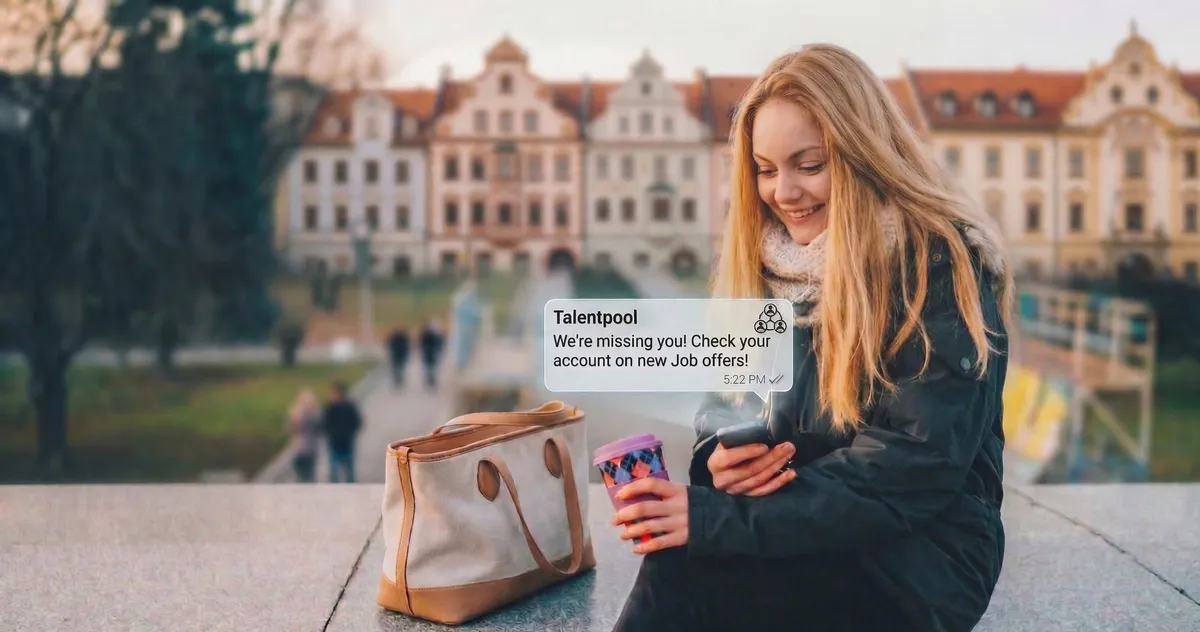
Multichannel strategy: WhatsApp, email, Instagram, push
Effective talent pool reactivation uses multiple channels in a coordinated sequence:
WhatsApp broadcast (primary)
The highest-reach channel. 98% open rate, under 90 seconds average response time. Use for direct role notifications and re-engagement messages. Approved templates ensure consistent messaging and Meta compliance. SendSeven's campaign builder lets you personalise at scale.
Email nurture (secondary)
Monthly or quarterly newsletter to talent pool subscribers. Less intrusive than WhatsApp, better for longer-form content: company news, culture updates, blog articles, events. Keeps the relationship warm between active WhatsApp broadcasts.
Instagram Story teasers (Gen Z segments)
If your employer brand on Instagram has active followers, story teasers for new roles ("We're hiring") drive DMs from interested candidates. Especially effective for creative and tech roles where your Instagram audience overlaps with your talent pool target group.
Browser push notifications (job alerts)
For candidates who have opted in to push notifications via your careers page: instant notifications when a relevant new role is posted. Zero-friction, high timeliness. Works on desktop and mobile without an app.
ROI: talent pool vs. new acquisition
The business case for talent pool investment is compelling:
| Metric | New acquisition | Talent pool reactivation |
|---|---|---|
| Cost per hire | EUR 4,500–9,000 | EUR 50–200 |
| Time to first interview | 14–21 days | 2–5 days |
| Qualification fit (pre-screened) | Low | High |
| Offer acceptance rate | ~65% | ~80% (known company) |
| Ramp-up time | Standard | Often shorter (familiar with culture) |
A recruiting team that fills 20% of openings from its talent pool instead of new acquisition saves EUR 90,000–180,000 per year on a 100-hire baseline — while improving time-to-fill and offer acceptance simultaneously.
Conclusion
Your talent pool is your most underutilised recruiting asset. The candidates are pre-qualified, already familiar with your company, and significantly cheaper to convert than new applicants. The only missing piece: a reliable, GDPR-compliant channel to reach them. WhatsApp broadcasts with 98% open rate, combined with email nurture and Instagram Story teasers, make talent pool reactivation a high-ROI, repeatable process.
Further reading:
- Recruiting Messaging Guide 2026
- Stop Candidate Ghosting with Multichannel Messaging
- GDPR in Recruiting Messaging
- SendSeven for Recruiting: Overview
- Guide: Set up WhatsApp Business API
- Glossary: Talent Pool
FAQ
Can I just message candidates from my ATS via WhatsApp?
No. Without explicit opt-in, this is not permitted under GDPR. WhatsApp is treated as a direct communication channel requiring separate consent. Collect the opt-in at the time of application, at rejection, or via a re-consent email campaign.
How many candidates typically respond to a reactivation campaign?
Response rates depend strongly on opt-in recency and message relevance. Segmented WhatsApp campaigns with personalised content achieve response rates of 15–40% in practice. Generic broadcasts without segmentation perform significantly lower.
How often can I contact my talent pool via WhatsApp?
There is no legal maximum frequency, but the rule of thumb is: maximum once a month for general updates, more frequently for specific matching roles. Too-high frequency leads to opt-outs and damages your employer brand.
Can I start broadcasts directly from my ATS?
That depends on your ATS. Most systems lack native messaging functionality. SendSeven connects to common ATS platforms via Zapier or n8n, so you can launch segmented campaigns from SendSeven, fed by ATS data.
What happens to candidates who don't respond to a win-back campaign?
Remove them from your active talent pool and, after the GDPR retention period has elapsed (typically 6 months after last contact without response), delete them from your records. This keeps your pool clean and ensures ongoing GDPR compliance.