Stop Candidate Ghosting: How Multichannel Messaging Triples Response Rates
SendSeven Team, Editorial Team
In a February 2021 Indeed survey, 76% of employers said a candidate had ghosted them in the past 12 months. A common reason: too-slow communication through the wrong channel. This article shows how to build a multichannel strategy with WhatsApp, email, and Instagram that keeps candidates engaged.
TL;DR
In a February 2021 Indeed survey, 76% of employers said a candidate had ghosted them in the past 12 months. A common reason: too-slow responses through the wrong channel. Recruiting emails average only 20–25% open rate. WhatsApp reaches 90–98%. A structured multichannel sequence (WhatsApp first contact → email follow-up → SMS reminder) reduces ghosting markedly and triples the response rate compared to email-only strategies. Back to the overview: Recruiting Messaging Guide 2026.
Why candidates ghost: 5 causes
Ghosting in recruiting means a candidate goes suddenly silent without explanation. It is rarely a sign of disrespect. It is usually a symptom of structural communication problems on the recruiter's side. Candidate ghosting stems from a predictable set of causes:
- Too-slow responses. Candidates who don't hear back within 48 hours lose interest or have accepted another offer in the meantime. In a market where top candidates are actively searching for an average of only 10 days, every lost day is critical.
- Received a better offer. The candidate has committed to another company in the meantime. They don't communicate this because the relationship with the recruiter is still too weak to motivate a formal rejection.
- Poor candidate experience. According to industry surveys, 72% of candidates report negative experiences in the application process. No status updates, no personal outreach, standardised mass emails. That doesn't build trust or engagement.
- Lack of process transparency. Not knowing what happens next: when the next interview takes place, who makes the decision, when a response can be expected. The candidate loses emotional connection to the process.
- Conflict avoidance. Rejections are uncomfortable. Many candidates avoid the direct conversation and choose silence. Giving them a simple, low-friction way to respond (a WhatsApp button, a short SMS) significantly increases the likelihood of a reply.
The good news: all five causes are addressable through structured multichannel communication — without investing more time, just through smarter channel use.
The email blind spot: 20% open rate in recruiting
Most recruiting processes still run primarily through email. Application received by email, interview invitation by email, status update by email, rejection by email. The problem: candidates frequently don't open these emails.
In the recruiting context, open rates for outreach emails are 20–25% (DMA/Mailchimp benchmarks). That means three out of four candidates never even see your message — not because they're ghosting, but because your medium isn't reaching them.
The comparison makes the difference clear:
| Channel | Open rate | Average response time | CTR |
|---|---|---|---|
| 90–98% | < 90 seconds | 45–60% | |
| SMS | Seen within minutes | ~90 seconds | 19–36% |
| 20–25% | 6–24 hours | 2–5% |
Sources: Mobilesquared (WhatsApp), DMA (email).
The channel determines whether your message reaches the candidate at all — before content even matters. Recruiters who use WhatsApp as the primary channel for time-critical communication report 4–5x higher response rates compared to email-only strategies.
This doesn't mean abandoning email. Email remains important for formal communication, contract documents, and detailed job descriptions. But for first contact, status updates, and appointment reminders, it is the wrong tool.
The multichannel workflow: 4 steps against ghosting
The most effective anti-ghosting strategy combines multiple channels in a structured sequence, calibrated to the moment and the candidate's expectations. Here is the recommended workflow:
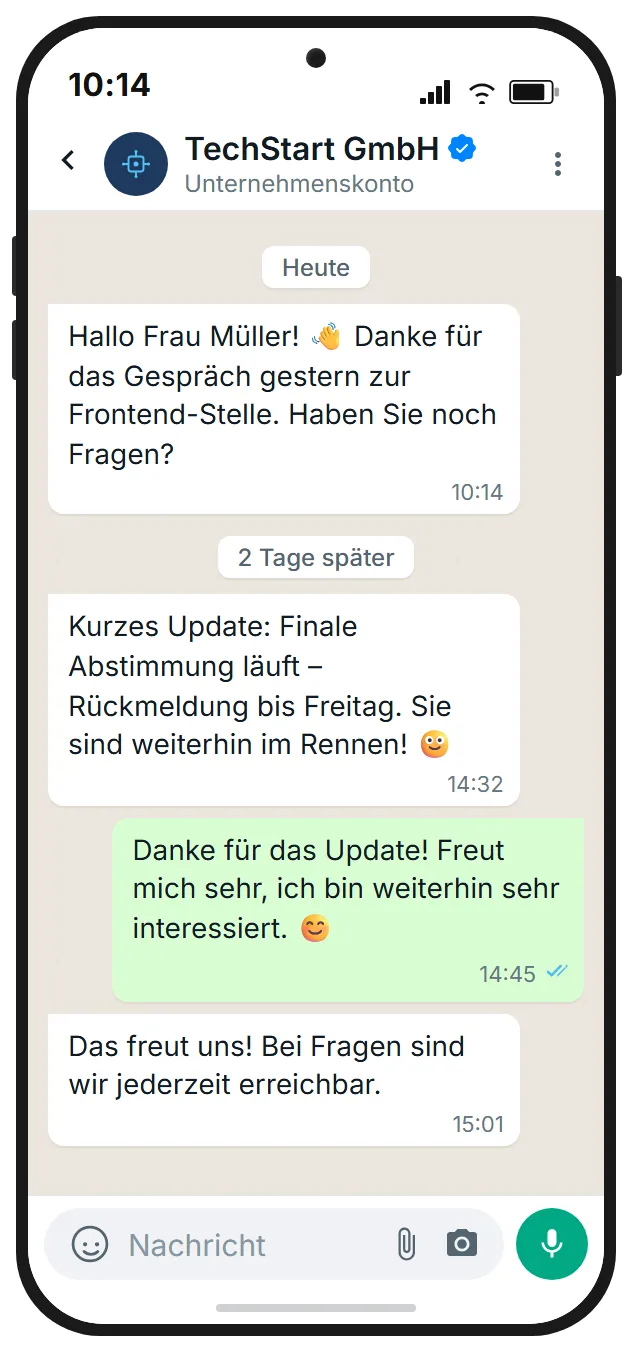
Step 1: WhatsApp first contact — personal, fast, direct
First contact via WhatsApp has decisive advantages: open rate up to 5x higher than email, average response time under 90 seconds, and the channel feels more personal than a formal email. Important: use the official WhatsApp Business API, not personal accounts. This protects candidate data and is GDPR-compliant.
A good WhatsApp first contact is: short (max 3–4 sentences), personal (name, reference to the person or role), clear about expectations (what happens next?), and low-friction in the response (a simple yes/no question or a confirmation button).
Step 2: Email follow-up with details
Once the candidate has responded via WhatsApp (or after 4 hours without a reaction), an email follows with detailed information: job description, company details, next steps. The email complements WhatsApp but doesn't replace it. Candidates who were first contacted via WhatsApp open the follow-up email with significantly higher probability because a connection already exists.
Step 3: Instagram DM for Gen Z
For candidates under 30, especially in creative, technical, or media-related roles, an increasingly accepted communication channel. Companies with an active employer brand on Instagram reach younger audiences through recruiting posts, stories, and reels — and interested candidates reach out directly via DM. Instagram DM thus becomes the natural conversation starter for Gen Z talent.
Step 4: SMS reminder for appointments
SMS is the most reliable channel for time-critical reminders. SMS lands in the phone's native inbox and is usually seen within minutes, without any app installed. Use SMS specifically for interview reminders (24 hours before, 2 hours before) and for status notifications the candidate must see immediately. SMS is a reminder channel, not an outreach channel.
All four channels can be managed in a central Unified Inbox from SendSeven. No platform switching, no lost messages, complete channel history per candidate.
Automated sequences: timing is everything
The effectiveness of a multichannel anti-ghosting strategy depends not only on the channel — but also on timing. Too early feels pushy, too late and the candidate has already disengaged.
Recommended sequence after first contact:
| Time | Channel | Content | Goal |
|---|---|---|---|
| Immediately (Day 0) | Personal first contact, brief introduction, specific question | Get initial response | |
| +4 hours | Detailed job description, next steps | Provide details, solidify interest | |
| +24 hours | Short follow-up: "Did you see my message?" | Reduce ghosting risk | |
| +48 hours | Final follow-up with clear action option | Drive decision | |
| +72 hours | SMS | Final short reminder with interview proposal | Last contact attempt |
After 72 hours without response: mark the candidate as "inactive" and move them to the talent pool. Concentrate resources on active candidates.
This sequence can be fully automated in SendSeven: trigger-based messages that fire automatically when an application arrives or after a defined event (interview confirmed, role filled). Integration with your Applicant Tracking System via Zapier, n8n, or the REST API keeps candidate data in sync.
Example scenario: recruitment agency in Europe
An illustrative example, not a customer reference.
A mid-sized recruitment agency with 8 recruiters, focused on IT and engineering, 50 active roles simultaneously. The team was struggling with a chronically high ghosting rate and a growing backlog.
Starting position (before multichannel):
- Primary communication channel: email (85% of all contacts)
- Average candidate response time: 18–24 hours
- Interview no-show rate: 28% (nearly 3 in 10 scheduled interviews)
- Recruiter time spent on follow-up: 40% of working hours
Implementation (3 months):
- Introduced SendSeven as central communication hub
- WhatsApp Business API integration with approved templates
- Built a 4-stage outreach sequence (WhatsApp → email → WhatsApp → SMS)
- Automated interview reminders (24h + 2h before appointment)
- ATS integration via Zapier
Results after 90 days:
- Average response time: from 18–24 hours to under 2 hours
- Interview no-show rate: from 28% to 13% (−54%)
- Recruiter follow-up time: from 40% to 18% of working hours
- Placement speed: +22% faster time-to-fill
The recruiters reported: the most important thing was not the automation itself — it was finally knowing whether a candidate had read their message. WhatsApp read receipts created clarity where uncertainty had reigned before.
Measurement: the 4 KPIs against ghosting
What you don't measure, you can't improve. These four KPIs give you a complete picture of your anti-ghosting performance:
1. Response rate
The share of approached candidates who respond to your first contact. Benchmark: < 30% with email-only outreach, 60–80% with WhatsApp first contact. Measure the rate per channel separately to understand which channel works for your audience.
2. Time-to-response
Average time between your message and the candidate's reply. WhatsApp target: under 2 hours. Email benchmark: 6–24 hours. A long time-to-response is an early warning of impending ghosting. Intervene with a follow-up before the candidate checks out.
3. Ghosting rate
The share of candidates who disappear completely after initial contact: no response to follow-ups, no rejection, no sign of life. Segment by process stage: ghosting at first contact is different from ghosting after the second interview. Target: under 20% (entire process).
4. Channel attribution
Which channel generated the decisive contact: the first outreach, the appointment confirmation, the final acceptance? Channel attribution helps you focus your budget and time on the channels that actually deliver results. SendSeven tracks all channel interactions in the Unified Inbox with a complete contact timeline.
All four KPIs can be read directly from the SendSeven Analytics dashboard, without manual spreadsheet work.
Conclusion
Candidate ghosting is not an inevitable feature of modern recruiting. It is a solvable communication problem. The causes are well understood: too-slow responses, the wrong channel, lack of process transparency. The solution is structured: WhatsApp for first contact and follow-ups, email for details and documents, SMS for appointment reminders, Instagram DM for Gen Z audiences.
Teams that implement this multichannel strategy in an automated sequence reduce ghosting markedly and triple the response rate compared to email-only approaches. The technical effort is low. The impact on time-to-fill and candidate experience is substantial.
Further reading:
- Recruiting Messaging Guide 2026
- Halve Interview No-Shows with Automated Reminders
- Reactivate Talent Pool with Messaging Campaigns
- SendSeven for Recruiting: Overview
- Feature: Unified Inbox
- Guide: Set up WhatsApp Business API
- Glossary: Candidate Ghosting
FAQ
What is candidate ghosting and why is it increasing?
Candidate ghosting is the abrupt end of all communication by an applicant without explanation or rejection. It is increasing because the job market is candidate-driven in many segments: top talent has multiple offers simultaneously and responds to the employer that communicates fastest and most personally. Slow or impersonal processes are simply abandoned, often without a formal rejection.
What open rate do recruiting emails achieve?
Recruiting outreach emails typically achieve 20–25% open rate (DMA benchmark). That means three out of four contacted candidates never see your message. WhatsApp messages, by contrast, reach 90–98% open rate (Mobilesquared), with an average response time of under 90 seconds.
Is it permitted to contact candidates via WhatsApp?
Yes — with the right consent and via the official WhatsApp Business API. Candidates must have given their permission for WhatsApp contact before you reach out, for example via an opt-in form on your careers page or in the application form. SendSeven supports GDPR-compliant double opt-in with automatic audit trail.
How many follow-ups should I send after ghosting?
Industry recommendation: maximum 3 follow-ups over 72 hours, distributed across different channels (WhatsApp → email → SMS). After the third unsuccessful contact attempt, the candidate should be marked as inactive and moved to the talent pool — not deleted, as circumstances can change. More than 3 follow-ups in a short time feels pushy and damages your employer brand.
Can I connect anti-ghosting sequences to my ATS?
Yes. SendSeven offers native integrations via Zapier and n8n, plus a full REST API. Triggers from your ATS (new application received, interview scheduled, role filled) can automatically kick off a communication sequence in SendSeven without any manual recruiter intervention.