RCS Explained: The SMS Successor for Small Businesses
SendSeven Team, Editorial Team
RCS is the successor to SMS: business name, logo and a trust checkmark instead of an anonymous number, plus images and buttons, right inside the messaging app that is already on most smartphones. This article explains in plain language what RCS can do, who can receive it, what it costs, and how small and mid-sized businesses get started.
TL;DR
RCS is the successor to SMS: it runs in the messaging app your customers already have installed, no download required. Instead of an anonymous number, they see your business name, logo and a trust checkmark, plus images, tappable buttons and read receipts. In Germany, RCS now reaches around 70 million people according to the four carriers Telekom, Vodafone, O2 and 1&1. In the UK, Apple lists EE, BT, Three, O2, giffgaff and Tesco Mobile for RCS on iPhone; Vodafone UK is not on that list yet. In the US, RCS on iPhone has worked since iOS 18 through AT&T, T-Mobile, Verizon and dozens of smaller carriers. At SendSeven, RCS is available for verified businesses in Germany, on request via [email protected]; outside Germany, you reach your customers via SMS and WhatsApp.
What is RCS?
RCS is the successor to SMS. It already lives inside the messaging app that comes preinstalled on most smartphones (Google Messages on most Android phones, and Messages on iPhone from iOS 18, where the carrier supports it). Your customers do not download anything, do not sign up anywhere, and do not create an account. They open the same app they already use and find your message there.
For businesses, the commercial side of RCS is called RCS Business Messaging, or RBM for short. The difference from SMS is simple: instead of an anonymous number, your customers see your business name, your logo and a trust checkmark. Instead of 160 plain characters, they get a product photo, tappable buttons and a read receipt.
Put simply: RCS brings what your customers already expect from WhatsApp into the standard messaging app, with nothing to install.
What is the difference between RCS and SMS?
The short version: with SMS, your business stays anonymous. With RCS, it is recognizable. Everything else follows from that.
| Feature | SMS | RCS |
|---|---|---|
| Sender | Number or short text name | Business name, logo and trust checkmark |
| Text length | 160 characters per message | Long text, no 160-character limit |
| Images and video | Not supported | Photo, carousel and short video possible |
| Buttons | None, only a link in the text | Up to 11 suggested replies and actions |
| Delivery feedback | Delivery report only, no read receipt | Delivered, read and typing indicator |
| App required | No | No |
| Customer reply | As text | As text or with one tap on a button |
Two things stay the same: the message lands in the default app, and your customers can reply anytime. Everything in between is new. If you are only sending SMS today, our SMS marketing guide is a good place to start before you add RCS.
What does an RCS message look like to your customers?
To your customers, an RCS message looks like a normal chat, just with a recognizable sender: at the top of the chat, instead of a phone number, they see your business name with your logo and a trust checkmark. The checkmark means the sender has been verified and genuinely belongs to that business.
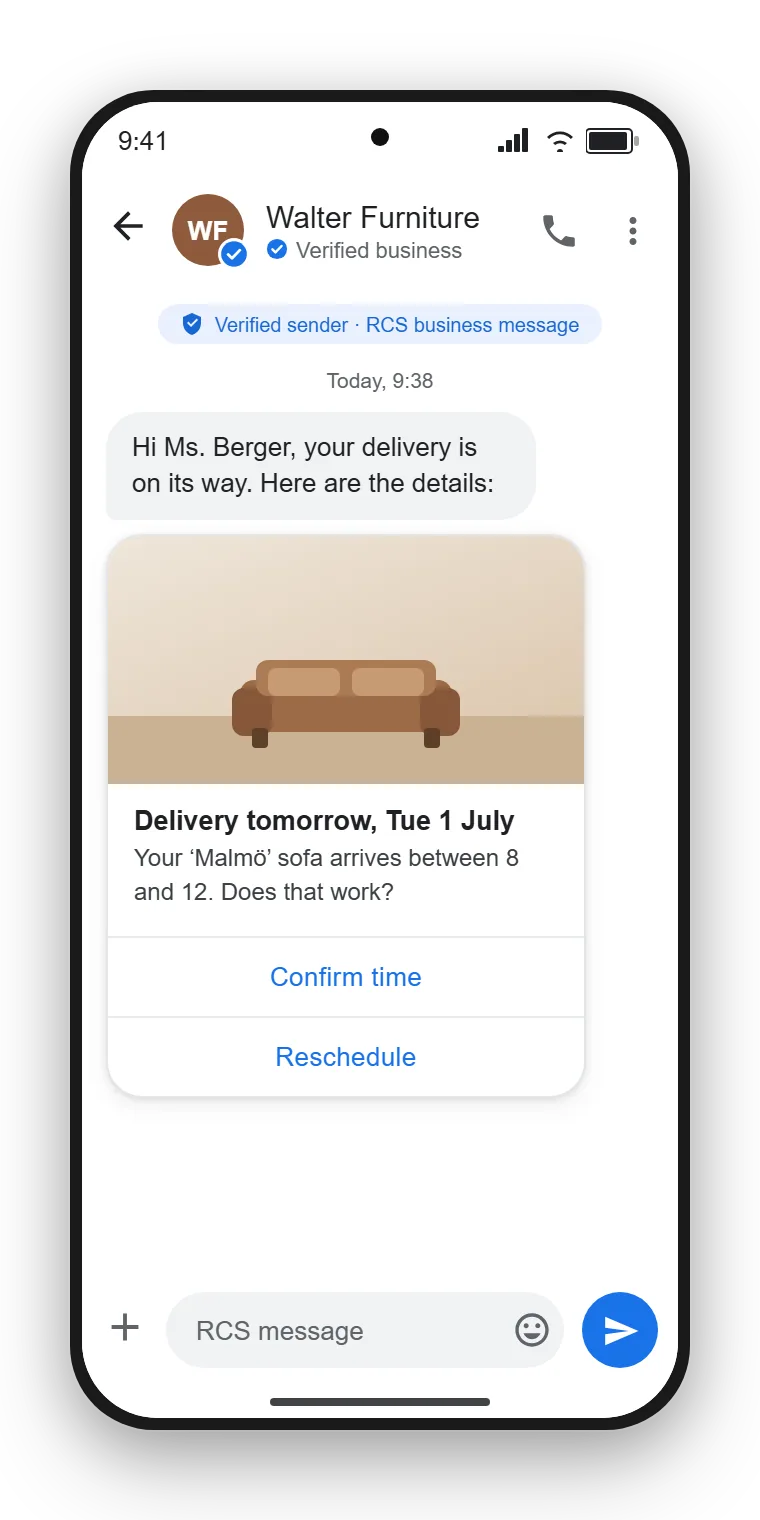
Inside the message itself, you get two building blocks that SMS does not have:
- Rich card: a card with an image, headline, short text and buttons. Good for an offer, an appointment confirmation or a shipment tracking update. Several rich cards can also form a swipeable carousel, using the same format as WhatsApp and Messenger carousels.
- Suggested actions: buttons beneath the message. One tap lets the customer confirm an appointment, call you, open directions in a maps app, or reply with a ready-made sentence.
To your customers, it feels like an ordinary chat. For you, the difference is measurable, because you can see whether the message was read and which button was tapped.
Who can receive RCS?
Reach depends on the market. In Germany, RCS now reaches around 70 million people, according to the four carriers Telekom, Vodafone, O2 and 1&1, who jointly support the standard. On iPhone, RCS arrived in Germany with iOS 18.1.
In the UK, Apple lists EE, BT, Three, O2, giffgaff and Tesco Mobile as supporting RCS on iPhone; Vodafone UK, Sky Mobile, iD Mobile and Virgin Mobile are not on the list yet, according to Apple's carrier support page for Europe. End-to-end encrypted RCS between iPhone and Android, a separate feature for personal chats, is rolling out unevenly (EE and Three in beta, O2 without a timescale, Vodafone not supporting it), according to ISPreview UK, May 2026. It has no bearing on business messaging either way.
In the US, RCS on iPhone has worked since iOS 18 (September 2024), with AT&T, T-Mobile and Verizon on Apple's own list of supporting carriers, alongside dozens of smaller providers such as Cricket, Metro by T-Mobile and US Cellular, according to Apple's carrier support page for the US. In May 2026 Apple also added end-to-end encryption for personal RCS chats between iPhone and Android, in beta with iOS 26.5; again, that is a consumer feature, separate from business RCS.
In practice, a large share of your customers in these three markets can receive RCS, but not everyone. Anyone on an older device, with RCS switched off, or on a carrier that has not rolled it out yet will not see an RCS message. For those customers, SMS remains the right channel. At SendSeven, SMS and, where available, RCS sit in the same inbox, so you do not need a second tool. One thing worth knowing: an automatic handoff from an RCS send to SMS is in preparation at SendSeven and not yet available, so for now you decide deliberately which group gets which message.
When does RCS pay off for a small business?
Anywhere an SMS works today but looks plain, and especially wherever you want to trigger a specific action. Four examples from small and mid-sized businesses:
- Appointment reminder with a button. Instead of "please call us," the customer taps "Confirm" or "Reschedule." That makes it easier to keep appointments on track, because replying costs one tap instead of a phone call.
- Shipping notification with a photo. Product photo, delivery date and a tracking button in one card. The customer does not have to copy or search for anything.
- Offer with a product photo. A carousel shows three items, each with its own button. What used to be a bare link in an SMS becomes visible.
- Service update that needs to land. Changed opening hours, a service disruption, a callback. The verified sender shows at a glance that the message really comes from you.
The rule of thumb: the more concrete the action you want from the customer, the more RCS adds. Plain information is served just as well by SMS.
What does RCS cost?
There is no public price list for RCS. Carrier terms vary by country, message type and volume, and at SendSeven, RCS is available on request for verified businesses in Germany. We price it per project once we know your use case and volume; reach out at [email protected] and our team handles onboarding directly, there is no self-serve sign-up.
Separately, the messaging platform itself runs on a fixed monthly plan, starting at €49 a month with a message allowance included; see the full plans on our pricing page. RCS terms are agreed separately for each project.
What should you check before you start?
Four things: consent, sender verification, encryption, and the customers RCS cannot reach.
You need consent. Like SMS, RCS is used for marketing, so nothing goes out without opt-in. At SendSeven, the opt-in step is part of the RCS flow itself, but the underlying rule does not change: under GDPR and UK GDPR/PECR in Europe, and the TCPA in the US, you generally need documented, specific consent before sending marketing messages to a mobile number. This is not legal advice; check your own consent wording against the rules that apply where your customers are.
Your sender gets verified. Before you can send, Google and your carrier check your brand identity: business name, logo and description. Only after that do you get a verified sender with the trust checkmark. How long the review takes depends on Google and the carrier and cannot be promised upfront, so build it into your timeline rather than assuming it is instant.
Encrypted, but not end-to-end. Business RCS messages are encrypted in transit to industry standard (TLS 1.3). There is no end-to-end encryption for business messages the way there is for some personal RCS chats. Treat the channel like email: fine for service updates and offers, not for highly sensitive data.
Not everyone is reachable. Plan SMS as a genuine second path, not a fallback you only reach for when something breaks. Knowing both channels lets you plan campaigns realistically.
How do you get started with RCS?
In five steps: pick an occasion, check your consent wording, get your sender verified, build and test a message, then measure. A sensible first step is small, not big:
- Pick an occasion. Take the message you already send most often, usually an appointment reminder or a shipping update.
- Check your consent. Look at the wording your customers agreed to when you collected their mobile numbers.
- Get your sender verified. Submit your business name, logo and description, then the review runs.
- Build and test a message. One image, one clear sentence, three buttons at most. Less works better.
- Measure and compare. Check read rate and button taps against your existing SMS.
At SendSeven, RCS is available on request for verified businesses in Germany; reach out to [email protected] to get started, and our team handles onboarding directly. If your business is outside Germany, SMS and WhatsApp are the channels to use today; WhatsApp also supports images, buttons and carousels. Our complete RCS guide covers the technology, security and comparison with WhatsApp in more depth.
Try SendSeven free for 14 days
SMS, WhatsApp and 6 more channels in one unified inbox. RCS is available for verified businesses in Germany, on request.
View pricing & start trial →Frequently asked questions
Do my customers need an app to receive RCS?
No. RCS runs inside the messaging app that is already on the phone. Your customers install nothing, sign up nowhere, and create no account. That is exactly what separates RCS from messenger apps like WhatsApp.
Does RCS work on iPhone?
Yes, from iOS 18 in the US and from iOS 18.1 in Germany, provided the customer's carrier supports RCS. In Germany, all four networks do. In the UK, EE, BT, Three and O2 do, while Vodafone UK is not on Apple's list yet. Plan SMS as a second path for everyone else.
What happens when a customer can't receive RCS?
Then you reach them by SMS. On SendSeven, both channels sit in the same inbox. An automatic handoff from an RCS send to SMS is in preparation and not yet available, so for now you choose deliberately which channel each group receives.
Do I need consent before sending RCS messages?
Yes. Like SMS, RCS is used for marketing, and you need the recipient's consent before you send. At SendSeven, the opt-in step is part of the RCS flow itself, but you still need a documented, specific basis under the rules that apply where your customers are (GDPR, UK GDPR/PECR, or the TCPA). This is not legal advice.
Is RCS available for businesses outside Germany?
Not yet through SendSeven. RCS at SendSeven is currently available only in Germany, for verified businesses, on request via [email protected]. Businesses elsewhere reach their customers on SMS and WhatsApp.
Should I use RCS or WhatsApp?
Both, for different jobs. RCS reaches customers with no app install, in the same inbox as their texts. WhatsApp reaches people who already chat there, and is end-to-end encrypted for personal use. You need consent for both channels alike. In practice, RCS tends to replace SMS rather than WhatsApp.
Is RCS more secure than WhatsApp?
Different, not simply more secure. Business RCS messages are encrypted in transit to TLS 1.3, not end-to-end. The real advantage sits elsewhere: your customers see the trust checkmark and know the message genuinely comes from you, which makes impersonation attempts much harder.
Related guides and further reading
Go deeper on RCS
Sources: Apple, carrier support in Europe (September 2026); Apple, carrier support in the US (September 2026); ISPreview UK, cross-platform E2EE RCS on UK operators (May 2026).