Browser Push or Email Newsletter? Which Channel for What (2026)
SendSeven Team, Editorial Team
Browser push and email newsletters compete far less than most people assume. They reach different moments, suit different content, and show their strength in combination. This comparison lays eight dimensions side by side, runs through two worked examples, and delivers a decision matrix that helps SMBs pick the right channel for every use case.
TL;DR
Browser push and email newsletters are not competitors but complements. Email reaches practically every internet user, keeps content visible for days, and carries long, designed messages. Browser push plays to its strength at the right moment: real-time, without a separate app, directly in the running browser. Anyone who thinks of both channels as a stack uses email as the workhorse for newsletters and longer content, and push as the real-time layer for promotions, price alerts, and re-engagement. This article compares eight dimensions side by side, works through two practical scenarios, and delivers a decision matrix by use case. Browser push is sent as a scheduled campaign via Reach or via REST API from your own system — often as a first touch, after which email or WhatsApp follow-up touches can be orchestrated in the Flow Builder. All responses land in the same unified inbox in SendSeven.
What the two channels share and what separates them
Browser push and email newsletters share more than their reputation suggests. Both require a voluntary opt-in, both allow withdrawal at any time, and both are suited for direct marketing to existing relationships. The decisive difference lies in the moment of delivery and the message format itself.
An email lands in a mailbox. It waits there until the recipient opens it. That might be an hour later, the next morning, or over the weekend. Content can be any length, can be designed, and carries images, tables, buttons, and logos. The email persists — its visibility window extends over days.
A browser push notification appears directly in the running browser or as a system notification on desktop and smartphone. It is short, real-time, and tied to active use. Anyone who never opens the browser never sees it. Anyone who opens the browser sees it immediately. The technical foundation is the Web Push API and a registered service worker.
This gives us the most important rule of thumb in this comparison: email carries content, push carries moment. If you have content, choose email. If you have a moment, choose push. If you need both, combine them.
Comparison table: eight dimensions at a glance
Eight dimensions decide in practice which channel fits which occasion. The table below lays them out side by side without judgment.
| Dimension | Email Newsletter | Browser Push |
|---|---|---|
| Reach (market) | Around 95 % of all internet users have at least one email address | 30–50 % of website visitors grant the opt-in, depending on the pre-permission strategy |
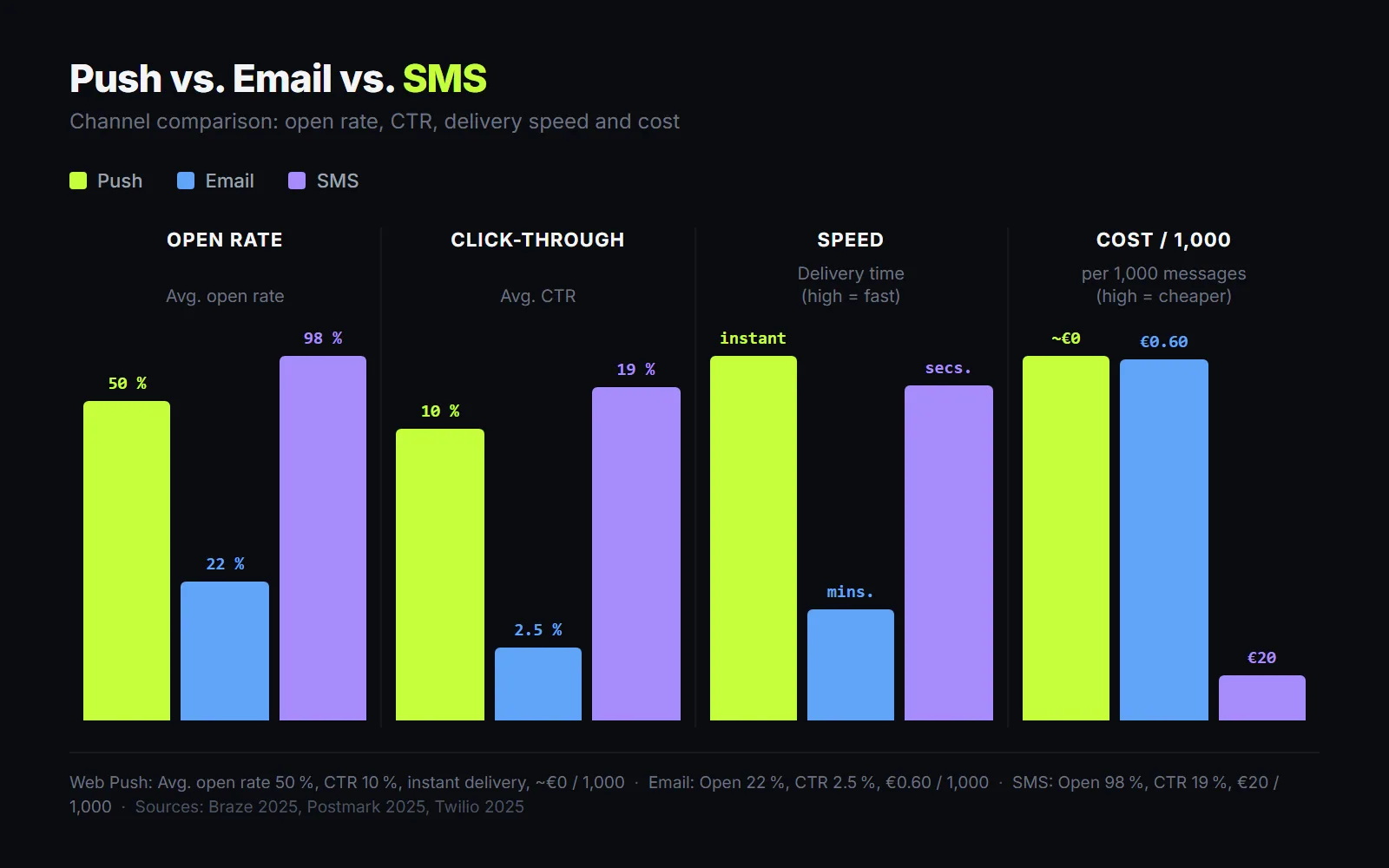
| Open rate / CTR | Open rate globally 22–28 %, click rate 2–4 % | Direct CTR 5–15 % once click-tracking is active (short URLs or UTM parameters) |
| Delivery latency | Seconds to minutes, depending on sending service and recipient mailbox | Real-time, typically under one second after trigger |
| Visibility window | Days to weeks, as long as the email sits in the inbox | 24–48 hours in the notification centre, then gone |
| Content volume | HTML, images, long text, multiple sections, full brand design | Short title, short body, one image |
| Personalisation | Deep: merge tags, dynamic sections, segmented content per recipient | Lean: title, body, tag or segment |
| Cost | Included in your SendSeven plan, from 49 € per month, plus a low per-email rate | Included in your SendSeven plan, from 49 € per month, plus a small usage-based cost per push sent |
| Setup effort | Hours to days: design templates, clean lists, set up double opt-in | 2–4 hours technically plus a pre-permission layer on the website |
The table shows: email is broader, longer-lived, and richer in content. Push is faster, more direct, and leaner. Both are set up in technically and legally comparable ways. The rest is a question of occasion.
Open rate, CTR, and latency compared
Three metrics are most often compared in a direct comparison, and precisely here are the most common misinterpretations.
The open rate is the central measurement for email. For SMB newsletters globally, the range typically sits between 22 and 28 %. With browser push, send and delivery are always logged; you measure a click rate once click-tracking is active — via SendSeven short URLs or your own UTM parameters. With active tracking, the click rate typically lands at 5–15 %, which looks impressive in comparison but refers to a smaller recipient base.
The click rate is therefore the more honest comparison value. Anyone who emails 10,000 recipients and achieves a 3 % click rate generates 300 clicks. Anyone who sends to 3,000 push subscribers and achieves a 10 % CTR also generates 300 clicks. The absolute number is similar, but the required recipient volume differs by a factor of three.
The latency is the most underestimated figure. Push beats email here not just by seconds but by hours. An email sent in the morning is on average opened in the afternoon. A push notification is on average seen within minutes, provided the recipient is at their device. For time-sensitive content such as price alerts, live auctions, or last-minute promotions, that is the decisive advantage.
When email clearly wins
There are occasions where email is the obvious right choice. Anyone using push here is giving away reach, content, or brand impact.
Longer content belongs in email. A newsletter with three articles, an editorial, and a product recommendation fills a full screen page. There is no room for that in a push notification with 60-character title and 120-character body. Anyone maintaining an editorial newsletter has the right format in email.
Older demographics use email naturally and browser push far less. The opt-in rate drops noticeably with the age of the target audience, partly because many older users consistently decline the browser's Allow prompt. Anyone serving a 55+ audience builds on email.
B2B newsletters benefit from email's architecture. Decision-makers check their inbox in the morning, archive important mailings for later, and forward them to colleagues. Push notifications fit poorly into that daily routine and are often blocked by default by senior decision-makers.
Multi-device availability is an email strength. An email lands once in the inbox and is available on every device that accesses that account. A push subscription applies per browser on per device. Anyone using three devices with three different browsers would need to grant the opt-in on each one, and every one is a separate subscription.
Compliance-heavy industries such as finance, insurance, and healthcare often work with email as an auditable delivery channel with defined logging. Browser push can also be operated in a GDPR-compliant way but is less established in heavily regulated sectors.
When browser push clearly wins
There are equally clear situations where push is the right choice and email would be too slow, too late, or too unwieldy.
Real-time events are browser push's home ground. A price alert that crosses a threshold. A live sports score that just changed. An auction ending in five minutes. Here every minute counts, and email simply arrives too late.
High-frequency news such as news portals, blog updates, and live reporting use push to keep the frequency high without flooding the recipient's inbox. Push subscribers tolerate more frequency than email subscribers because a push notification removes itself from the notification centre after a short time.
Re-engaging inactive website visitors is probably the most underestimated use case. Anyone who visits a website and grants the push opt-in leaves no email address and no phone number. They can still be brought back once there is a relevant occasion. Push is often the only channel that works here at all. Anyone who wants to go deeper on this topic will find the detailed guide in the article on re-engaging inactive users.
E-commerce with cart abandonment benefits from the short reaction window. Anyone who leaves a cart and returns to the same browser sees a push reminder with a higher probability than an email they open only the next day. Push sequences in the cart context regularly beat email sequences on conversion speed. Specific campaign structures for this are in the article on cart abandonment and price alerts.
When both channels together show their strength
The most common misconception in this comparison is the idea that a choice must be made. In practice, push and email complement each other in a stack where each channel plays to its strength.
A proven setup looks like this: email as the newsletter workhorse carries the weekly or fortnightly communication. It keeps existing customers warm, carries stories, long content, and brand identity. It is produced carefully and sent along an editorial calendar.
Browser push as the real-time layer takes on everything that needs speed: sale start, new episode, price threshold reached, last few places, appointment reminders, short-notice promotions. Push requires no preparation in the traditional sense because content is short and triggers are automatable.
Ideally both channels are synchronised. Anyone announcing a big sale sends an email the day before with all the details and on the sale day sends an additional push reminder with just three lines of text and an image, clickable to the destination. The email delivers the context, push triggers the action at the right moment.
The two channels are triggered separately: you send push as a scheduled campaign via Reach or, for an event such as a price being reached, via REST API from your own system. The downstream email, WhatsApp, and SMS touches can then be orchestrated without coding in the Flow Builder: a trigger fires (for example an incoming message, a contact tag being set, or an event your shop system reports via the REST API), a condition branches, a delay waits, an email or WhatsApp action follows. Browser push itself is not a channel in the Flow Builder — a flow cannot send a push. This builds a graduated communication stack in which every channel stands at its strongest position.
Worked examples: e-commerce and B2B
Numbers sharpen intuition. Two practical scenarios show how push and email differ in absolute click and conversion figures.
Scenario 1: e-commerce shop with 50,000 email subscribers and 15,000 push subscribers. Both channels promote the same sale.
- Email campaign: open rate 24 %, click rate 3 % across all recipients. Result: 1,500 clicks. At a 4.5 % shop conversion rate, that gives around 68 purchases.
- Push campaign: CTR 8 % across all subscribers. Result: 1,200 clicks. At the same 4.5 % conversion rate, that gives around 54 purchases.
- Observation: email has a slight edge in absolute numbers because the list is larger. Push generates clicks more efficiently per recipient, but the absolute volume per send is smaller. Per sale campaign, email wins narrowly; per subscriber, push wins clearly.
Scenario 2: B2B newsletter with 5,000 email subscribers and 800 push subscribers. Decision-makers rarely grant push permission and use it even less in their working day.
- Email campaign: open rate 32 % (B2B typically runs higher than B2C), click rate 4 %. Result: 200 clicks.
- Push campaign: CTR 7 % across all subscribers. Result: 56 clicks.
- Observation: in B2B, email dominates clearly. The push list is not just smaller but the probability of use is lower. Push works better here as a selective tool — for event reminders or webinar starts — rather than as the primary marketing channel.
The calculations confirm what theory suggests: push delivers clicks per subscriber more efficiently, but email scales through volume. Which ratio applies in your own business depends on list size, industry, and target audience. Anyone who builds both lists deliberately keeps both levers available.
Decision matrix by use case
| Use case | Recommendation | Rationale |
|---|---|---|
| Weekly content newsletter | Multiple sections, long content, brand design | |
| Sale start (time-critical) | Push (plus email as lead-up) | Real-time trigger beats delayed email |
| Price alert in an online shop | Push | Seconds not hours, triggered from the shop via the REST API |
| Re-engaging anonymous visitors | Push | No email address available |
| B2B decision-maker outreach | Push usage in B2B daily routine is low | |
| Cart reminder on the same day | Push (plus email for non-subscribers) | High conversion speed, triggered from the shop via the REST API |
| Webinar starting in 15 minutes | Push | Real-time reminder rather than inbox lottery |
| Detailed product announcement with specs | Images, tables, specifications need space | |
| Live score or result notification | Push | Email has no real-time value here |
| Compliance-relevant contract delivery | Auditable logging is the standard |
GDPR compared
Data protection differentiates the two channels less than is often assumed. Both require a voluntary, informed opt-in and both are GDPR-compliant when set up correctly.
For email newsletters, double opt-in has been the standard best practice for years. The recipient enters their address, receives a confirmation email, and clicks a link in it before being added to the list. The process is legally clean and usually activatable with a few clicks in a sending tool.
For browser push, a comparable logic applies in technical form: the visitor first sees a custom pre-permission layer on the website explaining what the permission is needed for. Only after active agreement is the operating system's browser prompt triggered. This two-step flow is considered best practice and is the double-opt-in equivalent for push.
Both channels must allow withdrawal at any time. For email that is the unsubscribe link in every message. For push it is the ability to deactivate the subscription in the browser or via an unsubscribe link in a push message itself.
Both channels require traceable logging: who granted the opt-in, when and how, what content was delivered, when a withdrawal occurred. SendSeven documents both channels along these obligations and operates hosting within the EU. For your data protection officer this means a comparable architecture in both cases.
Multi-channel stack: email, push, WhatsApp, SMS
Anyone who thinks one step further sees: push and email are two building blocks of a larger channel stack that, depending on the occasion, also includes WhatsApp and SMS. Each channel has its natural use case.
Email carries the newsletter, transactional mail, and longer marketing messages. It is the channel with the highest reach and the longest visibility window.
Browser push takes on time-critical occasions that unfold their impact in the active browser window or as a desktop notification. It is the fastest channel with the lowest opt-in barrier.
WhatsApp maintains the personal connection. Service enquiries, confirmations, individual consultations. Response times are short here and conversion rates on personalised content are highest.
SMS is the robust backup channel. An SMS reaches the recipient almost guaranteed, even without internet, even without mobile data. It is more expensive per message but unbeatable in emergency and confirmation scenarios.
SendSeven bundles these channels in a unified inbox where the team works with all conversations across all channels. Email is sent via SendSeven directly, as its own channel with newsletter functionality, without needing an additional service provider. Push notifications can likewise be triggered directly from SendSeven without building a custom backend. This means send and responses for both channels run together in one platform.
Orchestrate push and email together
Browser push as the real-time layer, email as the newsletter workhorse: with SendSeven you combine both channels without development effort and keep all responses in the unified inbox. Incoming messages are always free; the entry point starts at 49 € per month for all 8 channels.
View pricingFurther reading
This comparison has covered the strategic level. Anyone who wants to go deeper on the browser push channel will find the right material in the following articles.
- Browser Push Notifications 2026: the underestimated re-engagement channel for SMBs
- Winning back inactive users with browser push: sequences, triggers, example campaigns
- Browser push in e-commerce: cart abandonment and price alerts
- WhatsApp Newsletter 2026: the full setup guide, for teams running WhatsApp alongside push and email
The push channel itself is introduced on the push channel page, the email channel on the email channel page. You send push as a scheduled campaign via Reach or via REST API; for downstream email and WhatsApp touches, the Flow Builder and the unified inbox are worth a look.
Frequently asked questions
Browser push or email newsletter — which channel suits what?
Email newsletters suit longer content, editorial pieces, B2B decision-makers, and all occasions that benefit from a long visibility window. Browser push suits time-critical occasions, real-time triggers, re-engaging anonymous website visitors, and short attention triggers. In practice, SMBs combine both channels because they serve different moments.
Is the click rate of browser push higher than email?
Once click-tracking is active (via SendSeven short URLs or your own UTM parameters), the push click rate at 5–15 % is typically above the email click rate of 2–4 %. However, push refers to a generally smaller recipient base. In absolute click numbers per campaign, email is often level or ahead because the list is larger.
Do I need both or is one channel enough?
For many SMBs both are worthwhile. Email as the reliable main channel with high reach and long visibility, push as a complementary real-time layer for time-critical occasions and re-engagement. Anyone with only one channel should start with the one that fits the target audience and add the other later.
How much does browser push cost compared to email?
Push and email are both included in the same SendSeven plan, starting at 49 € per month for all 8 channels. Email has its own lower per-message rate; push uses your plan's blended message rate. Incoming messages are free in both cases.
Can both channels be used in a GDPR-compliant way?
Yes. Both channels require a double opt-in or its technical equivalent in the form of a pre-permission layer before the browser prompt. Both allow withdrawal at any time and require traceable logging of opt-ins. SendSeven operates both channels from EU hosting and provides a Data Processing Agreement.
Which channel is better for cart abandonment?
Browser push often has the edge in a cart context because the recipient is usually still on the same browser and sees the reminder within seconds. Email is the complement for recipients who do not return or have not granted a push opt-in. In combination both channels deliver the highest recovery rate.
Do browser push recipients see messages on all their devices?
No. A push subscription applies per browser on per device. Anyone using different browsers on desktop and smartphone would need to grant the opt-in on each one separately. Email lands once in the inbox and is available on every device that accesses the account.
Can I send push and email from one platform?
Yes. SendSeven integrates browser push directly as its own channel: you send push as a scheduled campaign via Reach or via REST API from your system. Email runs in SendSeven as its own channel, and downstream email and WhatsApp touches can be orchestrated in the Flow Builder when needed. Responses from both channels land in the unified inbox where your team processes all replies in one place.