Browser Push for Win-back: Re-engaging Inactive Users in 2026
SendSeven Team, Editorial Team
Winning back inactive users with browser push is considerably cheaper and wider-reaching than a traditional email newsletter. This guide shows when users count as inactive, which win-back stages work, what a GDPR-compliant setup with a pre-permission layer looks like, and what ROI SMBs can realistically expect.
TL;DR
Winning back inactive users via browser push is significantly cheaper and wider-reaching than a traditional newsletter. Anyone with a push opt-in reaches on average 5–15 % of recipients with a click, versus 2–3 % for email. That translates for most SMBs into a three-to-four-times higher win-back ROI. The key ingredients are a clear definition of "inactive" (typically 14, 30, 60, or 90 days without login), a staged ladder with meaningfully different tones, sparing timing in the morning or early evening, and an honest sunset strategy after six months without response. The whole thing is implemented as a series of scheduled push campaigns via Reach targeting inactivity segments, with reactions collected in a unified inbox.
What re-engagement via browser push means
Re-engagement via browser push means reaching users who once registered for notifications through the browser opt-in but have been quiet for a while. No login, no purchase, no click. The push permission exists — so the relationship is there — the most recent activity is just some time ago.
Technically this works through the Web Push API and a service worker running in the background in the browser. The advantage for you: you need neither an email address nor a phone number. Once someone has clicked Allow they are addressable — anonymous, but directly on their device.
Re-engagement push is therefore not a loud advertising channel but a quiet offer to come back. That is an important distinction. Anyone who uses push as a sales megaphone loses subscribers as fast as they gained them. Anyone who understands it as a gentle return incentive builds, over time, a second audience that no other channel reaches as cheaply.
Why browser push beats email for win-back
The newsletter remains a reliable workhorse — especially for detailed content, receipts, and confirmations. For pure re-engagement campaigns, browser push outperforms it on three dimensions.
The click rate is considerably higher. Re-engagement emails in the UK and globally typically achieve 2–3 % click rate, with many falling below that. Browser push settles at 5–15 % CTR with good list hygiene, once click-tracking is active (via SendSeven short URLs or your own UTM parameters — delivery and dispatch are always logged regardless). Anyone wanting to win back 5,000 inactive users will therefore regularly reach three to four times as many returnees via push as via email.
Visibility is immediate. A push message appears directly on the device, even when the website is not open. It does not land in an overflowing inbox, does not compete with the promotions tab, and does not wait for someone to check their mail. For re-engagement, which often needs to fire within a narrow time window, this difference is significant.
Latency is low. Between send and seen there are often only seconds. Anyone announcing a time-limited offer or extending a promotion has a tool that works faster than any newsletter.
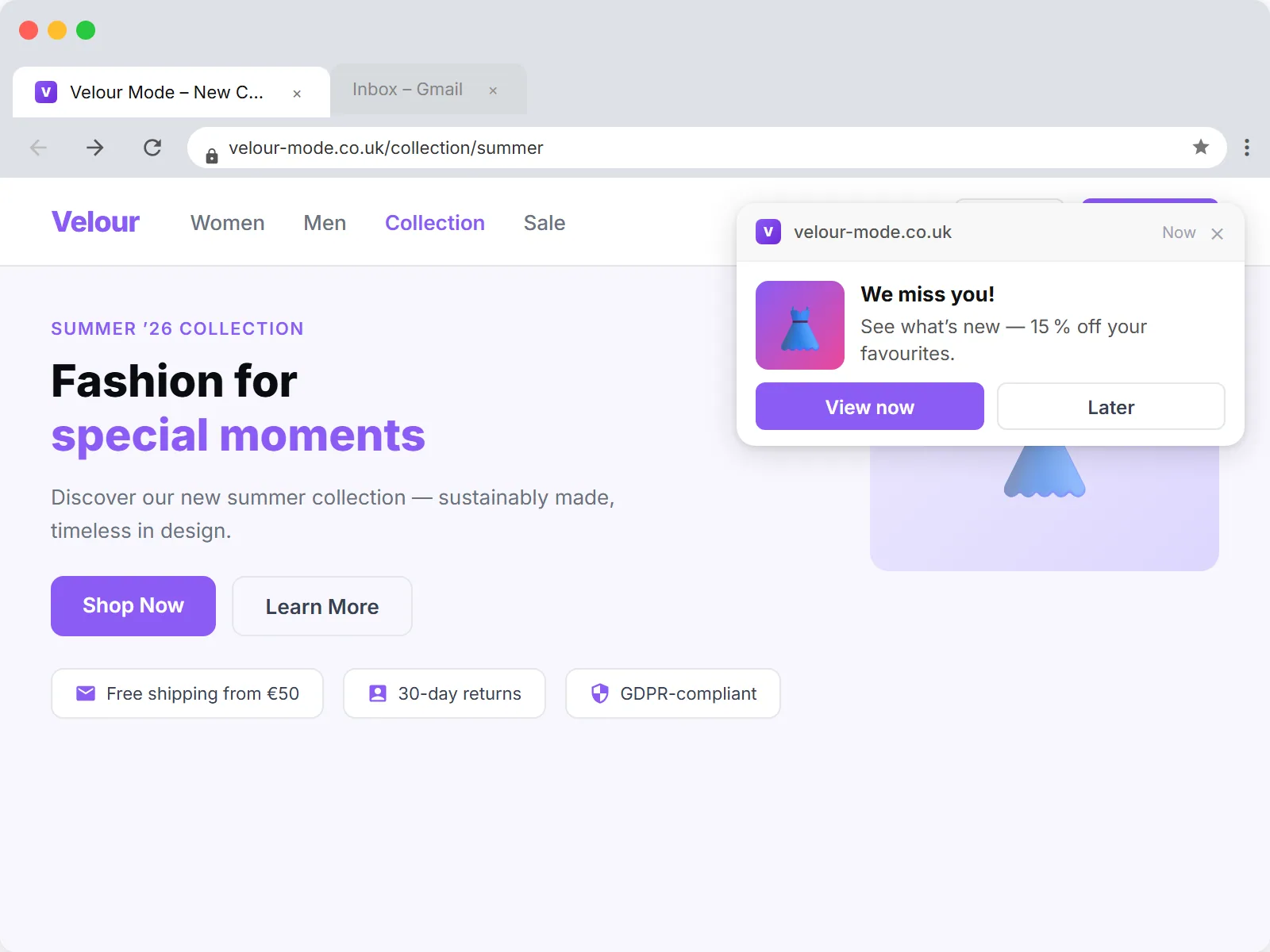
An honest note on reach: push only reaches users who once clicked Allow. Email reaches everyone with an address on your list. In a direct comparison push wins on ROI because engagement rates are higher and unit costs are lower. In raw reach volume, email is ahead for most SMBs. The right answer is therefore not either/or but both in a unified inbox — push for the first re-engagement stages, email for the detailed follow-up.
Who actually counts as "inactive"?
Before you launch a win-back campaign, you need a clear answer to one question: from when is a user inactive for you? The answer depends on your business model. A fashion shop has a different rhythm from a B2B tool, a restaurant different from a garage.
For most SMBs, four stages make practical sense:
- 14 days without activity: early warning. The user was around recently but has gone cold. Ideal for gentle reminders.
- 30 days: the classic win-back threshold. The relationship is still alive but needs an occasion.
- 60 days: a higher-effort approach is warranted. A concrete value or occasion often helps here.
- 90 days: the final stage before sunset. Anyone who has not responded here has almost certainly moved on permanently.
These stages are not dogma. A shop with a short purchase cycle can halve every stage. A B2B provider working on a quarterly rhythm can skip the first two.
For context on where browser push sits in the landscape, the bar chart below shows typical re-engagement CTR ranges. The order of magnitude matters more than the decimal place.
Typical re-engagement CTR by channel (2026)
Source: SendSeven. Values are mid-range estimates from typical SMB campaigns. SMS benefits from high attention but costs significantly more per message than browser push.
Reading guide: SMS is clearly ahead but carries a carrier fee per message. Browser push achieves a multiple of the email CTR, with no carrier or telco fee like SMS and only very small usage-based costs per push. For pure re-engagement — where volume and unit costs matter — that is the most economical combination.
Segmentation strategies for effective re-engagement
A win-back campaign that addresses all inactive users identically wastes the biggest lever. Four segmentation axes work particularly well in practice:
- Last-activity time: how long ago was the last action? 14, 30, 60, or 90 days. This axis decides which tone is appropriate.
- Product or topic affinity: which pages, products, or categories did the user view before going inactive? Someone who browsed hiking boots needs a different nudge from someone who was looking at running jackets.
- Conversion history: has the user ever bought, or never converted? Existing customers who go cold need a different tone from first-time visitors who never reached conversion.
- Lifecycle stage: is the user at the beginning of their relationship with you, in the middle of an active usage window, or near exit? This assessment comes from combining the first three axes.
From this matrix come practical segments that are individually small but collectively powerful: "first-time visitor for womenswear, 30 days inactive" or "existing customer, 60 days without booking". That precision makes all the difference versus a spray-and-pray campaign.
The win-back trigger ladder: day 14, 30, 60, 90
A single re-engagement push is rarely enough. What works is a ladder of three to four stages that gets gradually louder over time without becoming rude. The following building blocks have proven themselves with SMBs.
| Stage | Trigger | Tone | Example copy |
|---|---|---|---|
| Day 14 | 14 days without activity | Gentle, friendly | We missed you — see what's new |
| Day 30 | 30 days without activity | Value-focused | Top content you have missed |
| Day 60 | 60 days without activity | Concrete incentive | Come back: 15 % bonus on your next order |
| Day 90 | 90 days without activity | Final stage + sunset option | Do you still want to hear from us? Tap here once |
The order matters. The first two stages deliberately avoid discounts — otherwise they overstimulate too early. Anyone who receives a voucher on day 14 learns that inactivity is rewarded. Only from day 60 does a concrete incentive make sense, and on day 90 the honest question is not about the next purchase but about whether the relationship still exists at all.
A note on voice: in the push itself, an informal tone often works better because a short device notification feels personal. In emails to the same audience you maintain the formal register your brand usually uses. Both can coexist, as long as the choice is deliberate.
Copy, timing, and A/B tests
Three craft levers decide the impact of each individual re-engagement push.
Copy. Keep the title short — ideally 30–50 characters. The body can run to 60–100 characters. A clear action belongs in it: check out, read, redeem, view. Personalisation lifts CTR noticeably, even if you can only use a first name or a city. Avoid pure promotional clichés and anything that reads as shouting. Push lives on closeness, not a megaphone.
Timing. Tuesday to Thursday between 10–12 am and 5–7 pm has proven a good send window. Morning hours find people in a productive mindset, receptive to short prompts. Evenings tilt towards consumer behaviour. Night sending is off limits. Anyone sending internationally accounts for time zones — otherwise a notification rings at the wrong moment for a subscriber in another region.
A/B tests (manual segments). Browser push in SendSeven has no dedicated A/B test module; you split your segment into two random halves and send two separate campaigns. Four useful axes: title variant (question vs statement), call to action ("come back" vs "view"), personalisation (with vs without first name), image (push with hero image vs text-only variant). Test only one axis at a time — otherwise you learn little. A group size of roughly 1,000 recipients per variant gives most SMBs usable signals.
Worked example: 12× ROI in e-commerce
Re-engagement has to pay for itself, otherwise it is an expensive hobby. The worked example below shows why browser push can deliver such disproportionate ROI for win-back campaigns. The assumptions are deliberately conservative.
Starting point: an e-commerce SMB with 50,000 push subscribers. 10 % of these — 5,000 — count as inactive after 30 days without activity. These 5,000 receive a win-back campaign at the day 30 stage, "value" tone.
5,000 inactive push subscribers × 8 % CTR = 400 returnees to the website × 5 % purchase conversion = 20 purchases × €60 average order value = €1,200 revenue from one campaign
Unlike SMS, browser push carries no carrier or telco fee — only the blended per-message rate included in your plan. On the Basic plan (49 € per month, 2,500 messages included), the 5,000 pushes in this campaign add only modest cost. Even if you count the full blended rate for all 5,000 sends at a generous €100, that is set against campaign revenue of €1,200 — roughly 12 times the cost. The number is a model calculation based on the assumed click and purchase rates above, not a guaranteed return.
Two honest qualifications. First: the high ROI depends on having an existing opt-in. Anyone who has not yet built a push audience needs to do that groundwork first. Second: this is additional revenue from a group that would have shown far less response to email re-engagement. Push therefore does not replace a channel — it unlocks previously underperforming reach.
Activate push as its own channel
SendSeven brings push re-engagement into the same campaigns area where your emails and SMS also run. Incoming messages are always free; the entry point starts at 49 € per month for all 8 channels.
View pricingGDPR and sunset strategy
Browser push has a comparatively straightforward starting point from a data-protection perspective. No direct contact details are collected. Rules still apply — especially for re-engagement campaigns.
Opt-in with pre-permission layer. The standard browser prompt works better when preceded by a custom explanation. A small info card on the page that states the benefit raises the opt-in rate from around 8–12 % without a pre-layer to 20–35 % with one. The user decides first whether they even want to see the browser's question, and says No reflexively far less often. This also documents the consent more cleanly: anyone who expressly confirmed before the browser dialog knows what they confirmed.
Timestamp and withdrawal. Store the time of the opt-in and make unsubscribing possible at any time — both in the browser itself and via a simple link in the push message. GDPR-compliant handling is cleanly documented with SendSeven's EU hosting from Augsburg, including a Data Processing Agreement.
Sunset strategy after six months. Anyone who has neither clicked a push nor visited the website in six months has almost certainly left for good. Deliberately pause that subscription. This protects your sender reputation, keeps the list clean, and prevents your push volume from slowly tipping into spam-adjacent noise. A sunset stage as a day-90 trigger — "Do you still want to hear from us?" — gives the recipient an honest choice before the pause takes effect.
Setup with SendSeven step by step
Setting up a win-back push campaign in SendSeven runs in four manageable steps:
- Activate the push channel. In the channel settings select browser push and enter your domain. Set up the pre-permission layer as a small info card on your site before the browser dialog is triggered.
- Translate inactivity into tags. SendSeven has no built-in days-since-last-login logic. Your own system or a scheduled job calculates the inactivity stages (14, 30, 60, 90 days) and sets a contact tag per stage. In the contacts area you build these into saved segments, combined with product affinity or lifecycle stage.
- Create the stages as scheduled campaigns. Each rung of the ladder (day 14, 30, 60, 90) is its own scheduled push campaign via Reach targeting the relevant inactivity segment. You choose the segment, add title, body, action link, and optionally an image, then schedule the send. The staging works because your system moves contacts into the next segment as their inactivity grows, and that segment then receives the matching scheduled campaign. Browser push is not a channel in the Flow Builder — a flow cannot send a push.
- A/B test manually. Browser push has no built-in A/B test module. Split your segment into two random halves and send each half a separate push campaign with a different copy variant. After a week, pick the stronger variant and schedule that campaign for the full audience.
The scheduled campaigns are then sent at the scheduled time and logged in the same unified inbox where your other channels are bundled. This makes it visible which user responded via which route, without having to switch between tools.
Anyone who has not yet set up a push channel will find the technical instructions in our setup guide. Anyone who wants to go deeper on the email comparison can read the push vs newsletter comparison. The cart abandonment and price alert e-commerce use case is covered in the e-commerce article. The big picture is in the pillar piece on the re-engagement channel.
Frequently asked questions
When does a user count as inactive?
It depends on the business model. For most SMBs, 14, 30, 60, and 90 days without login or interaction are useful thresholds. Online shops with a short purchase cycle can halve each stage; B2B providers working on a quarterly rhythm can skip the first two. What matters is a deliberate definition per campaign rather than adopting a default rule.
What CTR is realistic for a re-engagement push?
Well-maintained re-engagement push campaigns typically achieve 5–15 % click rate once click-tracking is active (via SendSeven short URLs or your own UTM parameters). Re-engagement emails usually sit at 2–3 %. This gives push opt-in recipients a typical win-back ROI three to four times higher than email.
How many stages should a win-back sequence have?
Three to four stages work well. Day 14 gentle, day 30 value-focused, day 60 with a concrete incentive, day 90 as the final stage with a sunset option. More stages rarely add value; fewer leave potential on the table.
Which browsers support browser push?
Chrome, Edge, and Firefox on desktop and Android support browser push fully. Safari on macOS supports push from version 13. Safari on iOS supports browser push from iOS 16.4 — but only if the user has installed your website as a web app via Add to Home Screen. Native app push is not the same as browser push.
What does a pre-permission layer actually deliver?
A preceding explanation layer raises the opt-in rate from around 8–12 % without a layer to 20–35 % with one. The user decides first whether they even want to see the browser's question and says No reflexively far less often. A rejection once given in the browser is almost impossible to reverse — which is why preparing the moment properly matters so much.
How high are the send costs per push message?
Unlike SMS, browser push carries no carrier or telco fee. The per-push rate is included in your plan's blended message rate, and plans start at 49 € per month for all 8 channels with a message bundle included. Even larger push volumes add only modest cost beyond that bundle. Incoming messages are always free.
What does a sensible sunset strategy look like?
After six months without response and without a website visit, the push subscription is deliberately paused. This keeps the list clean, preserves your sender reputation, and prevents active recipients from experiencing your volume as spam-like noise. Before the pause, an honest day-90 push asking whether the recipient still wants to hear from you is the right final step.
Is browser push win-back GDPR-compliant?
Yes, when set up correctly. The opt-in runs through the browser's permission dialog, ideally preceded by a pre-permission layer. Store the timestamp of consent, make unsubscribing possible at any time, and mention push use transparently in your privacy policy. SendSeven from Augsburg provides EU hosting and a Data Processing Agreement for this purpose.