Instagram DM or WhatsApp Business? Which Channel for What (2026)
SendSeven Team, Editorial Team
Instagram DM and WhatsApp Business are not competitors but two tools with different strengths. This comparison shows when to use which channel, what it costs and why you do not have to choose, when both run in the same shared inbox.
TL;DR
Instagram DM and WhatsApp Business solve different jobs. WhatsApp is strong when you want to reach many people with one message, because campaigns there regularly reach open rates around 98 percent. Instagram DM is strong in the personal dialogue that grows out of stories and comments. The good news: you do not have to choose. In SendSeven both channels come together in a shared inbox where the team and an AI assistant work side by side. WhatsApp follows Meta's per-message pricing, the entry point in SendSeven starts from EUR 49 per month on the Basic plan, with all 8 channels included, and incoming messages are always free.
Why this is not an either-or question
Many small and mid-sized businesses pose the question the wrong way round. They look for the one right channel and overlook that Instagram DM and WhatsApp Business serve different jobs. One is not better than the other. They simply play to different strengths, and that is exactly why they complement each other.
Put simply: WhatsApp is the channel when you want to actively reach many people, for example with a promotion or an appointment reminder. Instagram is the channel when contact grows out of the moment, because someone sees a story or comments on a post. Both end in a conversation with a single person, but the path there is a different one.
This article helps you place both channels realistically. By the end you will see which channel fits which occasion, what both cost, and why the truly good solution is not to choose but to bring both together in a shared inbox.
What WhatsApp Business is especially good at
The strength of WhatsApp Business lies in reach. In many markets WhatsApp is installed on nearly every smartphone and used daily. A message does not land in an inbox you open maybe once a day, it lands right on the lock screen.
Campaigns and broadcast: this is exactly where the biggest lever sits. With WhatsApp you can send approved templates to many recipients at once, such as a promotion, a reminder or a piece of news. WhatsApp campaigns regularly reach open rates around 98 percent in marketing. For comparison: with classic email marketing, open rates usually sit between 20 and 25 percent. If you want to place a message reliably in front of many eyes, WhatsApp is the stronger tool.
Service with high reliability: in customer service too, WhatsApp is dependable, because answers are seen and replied to quickly. A confirmation, a status update, a follow-up: all of it feels like a normal conversation on WhatsApp, the kind people have all day anyway.
The requirement for commercial use is the official WhatsApp Business API. SendSeven connects it as a Meta Business Partner through the official interface, not through the regular WhatsApp app on a personal phone.
What Instagram DM is especially good at
The strength of Instagram lies not in the reach of an active send, but in the personal dialogue that grows out of your content. People discover a product in the feed, watch a story and fire off a quick question. In that moment attention is at its highest.
Story and comment mechanics: here Instagram has its own logic. When someone reacts to one of your stories, that story reply comes in as a direct message and is often the warmest contact you will get, because the person is actively engaging with your content right now. A comment under a post is public at first, but it can be sensibly moved into a private conversation by having an incoming comment trigger an automated flow in SendSeven.
Personal advice rather than mass outreach: Instagram DM thrives on the individual conversation. A product question, a recommendation, a short exchange about a post: such conversations feel approachable and suit brands that become visible through images and stories. That makes Instagram less a send channel than a place where attention turns into a real conversation.
The requirement is an Instagram Business or Creator account with message access enabled in the Instagram app. You can read more about setup and practice in the guide Instagram for business.
Instagram DM and WhatsApp Business head to head
The following table sets both channels against each other using the criteria that matter most for the choice in practice. It shows there is no winner, but a clear division of labour.
| Criterion | Instagram DM | WhatsApp Business |
|---|---|---|
| Reach via send | No classic mass send | Campaigns to many recipients |
| Personal dialogue | Very strong, from story and comment | Strong, in direct conversation |
| Campaigns and broadcast | Not the focus | Core strength, around 98 percent open rate |
| Typical trigger | Story reply, comment, spontaneous question | Active send, service follow-up |
| Biggest strength | Closeness and conversation in the moment | Reach and reliability |
One thing to be clear about: Instagram DM is a dialogue channel and not a tool for high-reach mass sends. If you need both, that is personal conversations and high-reach campaigns, you combine the two channels. That is exactly what the shared inbox is for.
Which audience you reach where
Both channels are broadly established, but they tend to speak to different moments of use. You should know these differences without overstating them.
WhatsApp is the all-rounder. It is used across all age groups and is, for many people, the natural way to write to family, friends and increasingly to businesses too. If you want to reach as broad a customer base as possible directly, WhatsApp is the safe choice.
Instagram is the place of visual discovery. People are there to see content, find inspiration and follow brands. Contact grows out of that engagement. For businesses that become visible through images, stories and reels, Instagram is the natural entry into a conversation.
In practice the audiences overlap heavily, and often it is even the same person who reaches you on both channels. If a customer discovered you yesterday via Instagram and writes by WhatsApp today, that is not a contradiction but a hint that both channels belong together.
What the two channels cost
On cost there is an important difference you should know before you plan. It mostly concerns active sending on WhatsApp.
WhatsApp follows Meta's per-message pricing. For outgoing campaigns and certain message types, Meta charges a price per message that varies by country and message category. Meta sets these prices, not SendSeven. You will find the current terms on Meta's official overview at business.whatsapp.com.
Instagram does not have this per-message model. Here, regular sending is not charged by Meta per unit. For Instagram you pay the channel price in SendSeven, and the dialogue itself runs in personal conversation.
The SendSeven share is built the same way for both channels. You start from EUR 49 per month on the Basic plan, and incoming messages are always free. So you pay a small, predictable base amount per active channel. With WhatsApp, Meta's per-message prices for active sending are added on top; with Instagram, they are not. You will find a detailed breakdown of all plans on the pricing page.
Both channels, one pricing model
Whether Instagram, WhatsApp or both: you start from EUR 49 per month on the Basic plan, and incoming messages are always free.
View pricingWhy both belong in one inbox
The real answer to the Instagram-or-WhatsApp question is: both. And in one place. As soon as the messages from both channels arrive in a shared inbox, most of the trade-offs dissolve on their own, because you no longer jump back and forth between two separate worlds.
The decisive part is the cross-channel view. If the same customer writes sometimes by Instagram, sometimes by WhatsApp, you see both conversations in the same interface and spot the connection immediately. That makes your advice more personal and spares you the question of what was already discussed. The shared inbox use case shows what such an inbox looks like in practice.
The inbox also gives you the same tools for both channels: an AI agent for recurring questions, quick replies for common requests and a clean handover from the AI agent to a team member. So you choose the right channel per occasion without losing the overview. You can read more in the article Instagram and WhatsApp in one shared inbox.
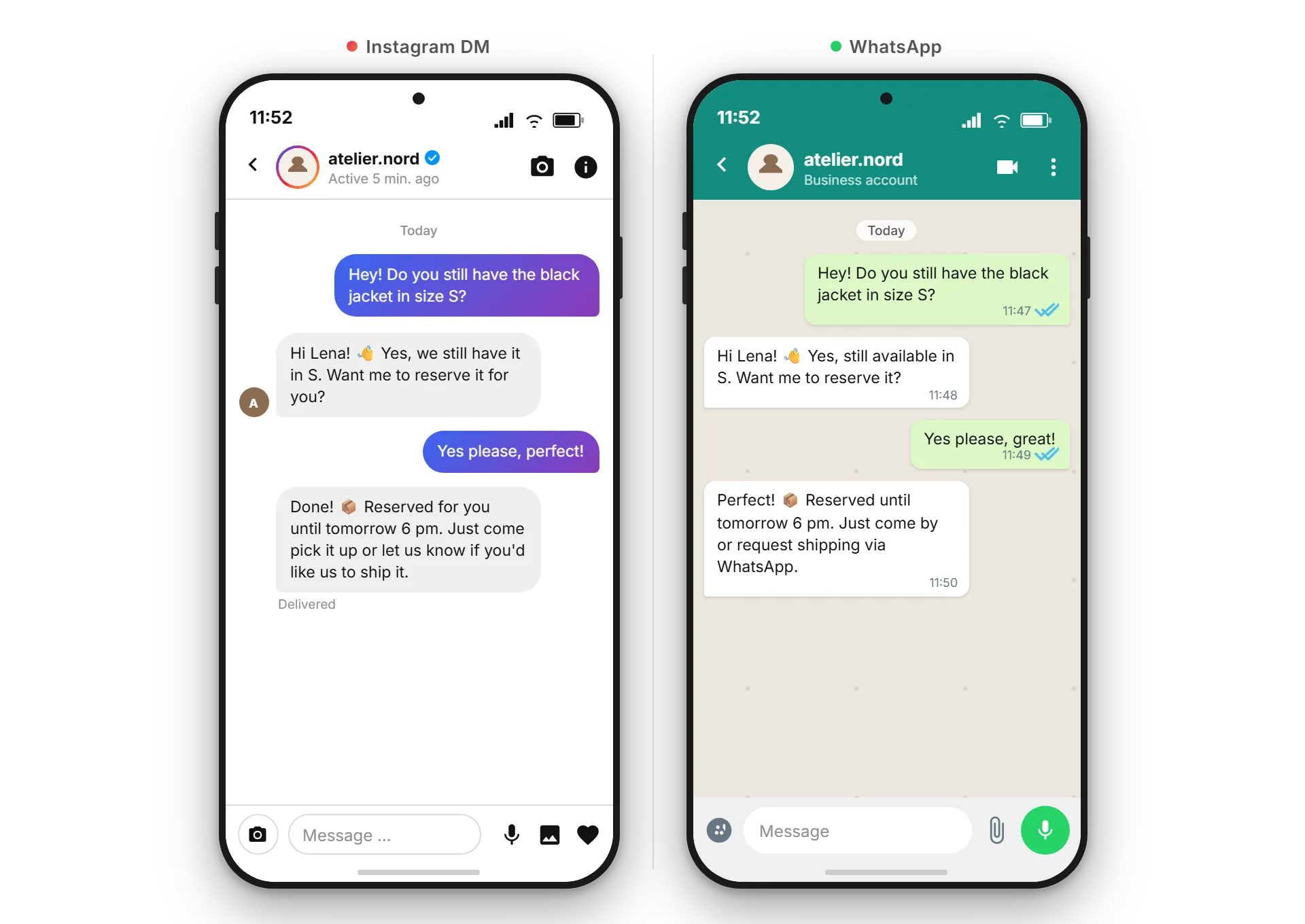
Example: choosing the channel per occasion
What does the division of labour look like in concrete terms? A simplified example for a mid-sized business that uses both channels.
Occasion 1, a promotion to many customers: the business wants to inform 800 existing customers about a time-limited offer. Here WhatsApp is the right choice, because an approved campaign template reaches many recipients at once and the open rate is high. Meta's per-message prices for the outgoing send apply, but in return the message lands reliably with nearly everyone.
800 recipients, one campaign. Reach counts, so WhatsApp. Meta's per-message prices are listed up to date on business.whatsapp.com, and SendSeven starts from EUR 49 a month on the Basic plan.
Occasion 2, a spontaneous question about a post: on the same day, someone replies to an Instagram story with a product question. Here Instagram is the right stage, because the conversation grows out of the moment. Incoming messages are free, and the AI assistant or a team member answers the question directly in personal dialogue.
Both occasions run through the same inbox. You choose the right tool per situation instead of committing to one channel on principle. That is exactly the advantage when reach and dialogue come together in one place.
Privacy and data protection for both channels
Both channels process personal data, so the same data protection ground rules apply to both. The advantage: in SendSeven, Instagram and WhatsApp stand on the same clean foundation.
Official connection instead of a personal phone: both channels are connected through Meta's official interface. Nobody has to use the regular Instagram or WhatsApp app on a personal smartphone, and no private contacts are uploaded.
EU hosting and data processing: SendSeven is the privacy-compliant foundation for your customer communication. As SendSeven GmbH, headquartered in Augsburg, Germany, we rely on EU hosting and provide the data processing agreement you need. Made in Germany, with data within the European framework.
Meta Business Partner: SendSeven is a Meta Business Partner and works for both channels exclusively through official interfaces. For your data protection officer that means a documented, compliant connection, no grey areas. On top of that, the usual obligations apply, such as a transparent privacy notice and a clear legal basis.
Read on: deeper-dive articles
This comparison places the two channels. In the following articles we go deeper, from the practice of the shared inbox to the automation of Instagram DMs.
- Instagram for business 2026: setting up DM, marketing and service the right way
- Instagram and WhatsApp in one shared inbox
- Automate Instagram DM with an AI assistant and a keyword bot
Frequently asked questions
Should I use Instagram DM or WhatsApp Business for my business?
Ideally both, because they serve different jobs. WhatsApp is strong when you want to reach many people with one message, Instagram is strong in the personal dialogue from stories and comments. In a shared inbox both channels can be run side by side.
Which channel is better suited for campaigns to many recipients?
WhatsApp. With approved templates you reach many recipients at once, and WhatsApp campaigns regularly achieve open rates around 98 percent in marketing. Instagram DM, by contrast, is a dialogue channel and not a tool for high-reach mass sends.
What can Instagram DM do better than WhatsApp?
Instagram is especially strong in the personal dialogue that grows out of your content. A story reply comes in as a direct message and is often the warmest contact you will get, and a comment can be moved into a private conversation. This closeness in the moment is Instagram's real strength.
How do the costs of Instagram DM and WhatsApp differ?
WhatsApp follows Meta's per-message pricing, which sets different per-unit prices for outgoing sends depending on country and message category. Meta sets these prices and publishes them on business.whatsapp.com. Instagram does not have this per-unit model. In SendSeven you pay one plan price for both channels, starting at EUR 49 per month on the Basic plan, and incoming messages are always free.
Do I reach the same audience on both channels?
The audiences overlap heavily, and often it is even the same person. WhatsApp is used across all age groups and is broadly established. Instagram is the place of visual discovery, where contacts grow out of viewing content. That is why both channels belong together.
Do I have to choose between Instagram and WhatsApp?
No. In SendSeven, Instagram DM and WhatsApp come together in a shared inbox where the team and an AI assistant work side by side. You choose the right channel per occasion and keep both conversations in view in the same interface.
Do I need an official connection for both channels?
Yes. WhatsApp is connected through the official WhatsApp Business API, Instagram through a Business or Creator account. Both connections run through Meta's official interface, not through the regular app on a personal phone.
Are Instagram DM and WhatsApp through SendSeven privacy-compliant?
Both channels are connected through Meta's official interface, without uploading private contacts. SendSeven relies on EU hosting, provides a data processing agreement and is a Meta Business Partner. On top of that, the usual obligations apply, such as a transparent privacy notice and a clear legal basis.