Messenger or WhatsApp Business? Which Channel for What (2026)
SendSeven Team, Editorial Team
Facebook Messenger and WhatsApp Business are not interchangeable tools. One reaches an older, Facebook-loyal customer base and shines for Click-to-Messenger Ads; the other is the broad mainstream channel with templates, authentication, and approximately 85% penetration in Germany. This comparison covers eight dimensions without declaring a winner and delivers an honest decision matrix for SMBs.
TL;DR
Facebook Messenger and WhatsApp Business both belong to Meta, but they are two distinct channels with clearly differentiated strengths. Messenger is the number-two channel in most markets, reaches roughly 36% of the German population (Bundesnetzagentur 2023, declining), is tightly integrated with the Facebook Page, and shines for Click-to-Messenger Ads targeting an older, Facebook-loyal audience. WhatsApp reaches approximately 85% of the German population, covers all age groups, and with templates, utility messages, and authentication templates offers a significantly broader playing field. This comparison covers eight dimensions without declaring a winner and delivers a decision matrix by use case. Those who want to can run both channels in a central inbox.
Both channels, one goal: what unites and divides them
Facebook Messenger and WhatsApp Business both belong to Meta. Choosing either means working with the same company, the same advertising guidelines, and in many cases a similar logic around approvals and interfaces. Yet in practice they are used in very different ways.
What unites them: both are asynchronous, both run on your customer's smartphone, both support images, buttons, and automated replies, and both offer a 24-hour service window after the last customer interaction during which you can reply without a template. On Messenger those replies are free; on WhatsApp they have cost the utility rate since 1 October 2026, once the first 1,000 per business phone number and month are used up. Both can be connected to a central inbox where your team handles enquiries from multiple channels.
What separates them is primarily the role each channel plays in your customers' daily lives. Messenger is deeply embedded in the Facebook ecosystem and is often used where people interact with a brand or page. WhatsApp is for many people their primary personal communication channel — the same one used with family and friends. This difference in proximity determines which channel suits which occasion.
Reach and demographics
Reach is the first point at which the two channels diverge significantly. In Germany, current surveys show roughly 85% of the population using WhatsApp regularly. WhatsApp is effectively the standard messenger across all age groups, from teenagers to grandparents.
Facebook Messenger is the clear number two behind WhatsApp in Germany and most European markets. Figures from the Bundesnetzagentur (2023) put Messenger at around 36% usage share, on a declining trend, while WhatsApp tops 90%. That is substantially less, but far from irrelevant. A common misconception is worth addressing: Messenger is not a young person's channel. According to the ARD/ZDF Media Study (2025), the average age of Facebook and Messenger users is around 45. The core lies in the 25–54 age group, with 25–34 the largest single segment, and the 45+ group continuing to grow. Gen Z and the under-25s have largely moved on to WhatsApp, Instagram Direct, Snapchat, and TikTok. The gender split is broadly even, with a slight female lean (approximately 51%, DataReportal 2025).
Messenger is also, for most users, a secondary channel. Around 77% of users run multiple messaging apps simultaneously, averaging more than three. WhatsApp is the primary channel in most European markets; Messenger runs in second or third place. The Facebook Marketplace sustains a meaningful share of Messenger usage through buyer-seller conversations, which creates a distinct transactional element.
A concrete example illustrates the difference. A furniture retailer whose customers are predominantly aged 35–65 will reach virtually all of them via WhatsApp and a good share additionally via Messenger. That older, working-age demographic is still at home on Facebook. A local streetwear brand with a young audience experiences the opposite: its followers have largely left Messenger for Instagram and TikTok, so Messenger as a channel reaches almost no one there. A business with a Facebook-engaged loyal customer base or one with active Marketplace listings benefits from Messenger; a young brand reaches very little of its target audience there.
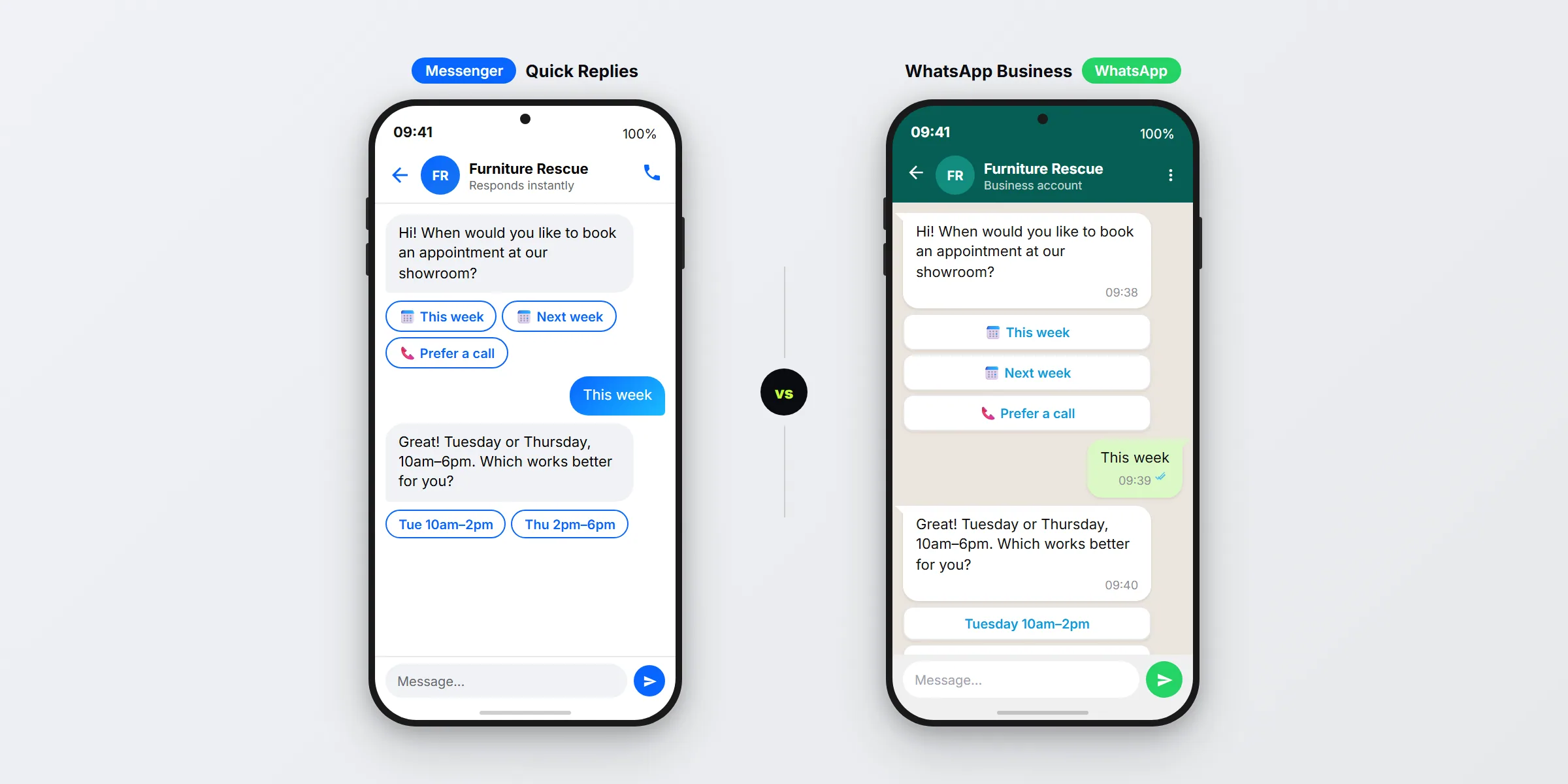
Comparison across eight dimensions
The table below places both channels side by side across eight dimensions without ranking them. Which column fits you better depends on your business, your audience, and your use case.
| Dimension | Facebook Messenger | WhatsApp Business |
|---|---|---|
| Reach (Germany) | ~36% of population active (number two behind WhatsApp) | ~85% of population active |
| Demographics | Smaller, older, Facebook-loyal (core 25–54, Marketplace-relevant) | Broad across all age groups, mainstream channel |
| Cost within service window | Free for 24 h after last user interaction | Since 1 October 2026: first 1,000 service messages per number and month free, then the utility rate (DE €0.0456) |
| Cost outside service window | No SendSeven charges outside the 24-hour window; Meta allows only a human agent's reply within 7 days or an approved Utility template, no promotions | Templates: Marketing €0.1131, Utility €0.0456, Authentication €0.0456 per message (DE, 2026) |
| Rich media | Images, quick replies, buttons, carousel, persistent menu | Images, video, interactive buttons, lists, carousel, templates |
| Bot capabilities | Send API with quick replies and cards | Cloud API with interactive buttons, list messages, and WhatsApp Flows |
| GDPR and hosting | Meta US servers; EU sub-processor via standard DPA | EU data residency available since 2023 |
| Setup effort | Facebook Page + Embedded Signup, usually live within hours | WABA + business verification; 1–2 days via Embedded Signup, otherwise up to 1–2 weeks |
The key differences in a sentence: Messenger is tightly integrated with the Facebook Page and extremely cost-efficient within the service window, but smaller in reach. WhatsApp is far more widely used and with templates and authentication messages covers a broader service mix, but every outgoing message costs Meta's per-message rate: templates always, and since 1 October 2026 also service replies beyond the first 1,000 per number and month.
When Messenger is clearly the better choice
Messenger plays to its strengths when three conditions combine: an active Facebook presence, a Facebook-loyal customer base, and a use case where the conversation originates from an ad, a post, or a Marketplace listing.
Three typical situations where Messenger is the better choice:
- Older, Facebook-loyal customer base. A business serving an audience aged 25–54 that is still active on Facebook day-to-day will find those customers inside the Meta ecosystem. This working-age demographic tends to bring stronger purchase intent and loyalty than the very young user base of TikTok or Snapchat — making Messenger interesting for B2C service and social commerce. Messenger is the closest channel.
- Facebook Page or Marketplace as the main presence. Local brands that have built their community on a Facebook Page over years, or that regularly sell via the Marketplace, benefit from the seamless integration. From every post, story, comment, and listing the conversation can flow directly into Messenger.
- Click-to-Messenger Ads as a performance lever. A Click-to-Messenger ad opens a chat with your Page on click. The first reply text can be prepared, the conversation is warm from the start. Within the service window that follows, follow-up messages cost nothing extra, which can significantly improve the efficiency of lead campaigns.
There is also a detail that makes a difference in practice: the Messenger Plugin can be embedded on your own website. Businesses with strong return traffic can direct visitors directly into Messenger without them leaving the page. For brands with high customer return rates, this is a quiet but noticeable advantage.
When WhatsApp is clearly the better choice
WhatsApp is the right choice when reach, mainstream acceptance, and a broad use-case mix take priority. Three situations where the channel is hard to beat:
- Broad audience across all age groups. For any business that needs a channel that reliably reaches customers aged 18 to 75, WhatsApp has the lowest barrier to entry. From the independent tradesperson to the pharmacy, it is the channel with the broadest coverage.
- Service mix of marketing, utility, and authentication. Any business that wants to handle appointment reminders, dispatch notifications, newsletters, and sign-up confirmations through one channel benefits from WhatsApp's clear category structure. Utility and authentication cost less than marketing, making the entire mix predictable.
- International or older audiences. WhatsApp is the standard messenger in virtually every market outside the United States. For older audiences it is often the only messaging app actively used. Businesses serving both domestic and international customers are on safe ground with WhatsApp.
One additional point: authentication use cases such as login codes, two-factor confirmations, and order confirmations are well-established on WhatsApp and billed clearly by category. Messenger does not support this type of structured flow in the same way.
When both channels make sense together
In practice, the question is rarely Messenger or WhatsApp but often both running in parallel. Three situations where the combination delivers noticeably more than either channel alone:
- Multi-generation business. A fashion retailer serving both younger buyers through Instagram and classic loyal customers aged 45+ covers both worlds: WhatsApp and Instagram for younger customers, Messenger additionally for the older, Facebook-loyal segment that is still active there.
- Brands with a strong Instagram presence. Instagram Direct Messages are not technically identical to Messenger, but they belong to the same Meta ecosystem. Combined with WhatsApp, this creates a trio where each platform plays to its strengths.
- Performance marketing with a separated stack. Click-to-Messenger Ads often yield a lower cost per click; Click-to-WhatsApp Ads often drive higher close rates. Running both in parallel and analysing the results finds the lever that works for a specific audience. SMS as a third channel adds value where time-critical service messages are needed.
The decisive point is that both channels do not need to be managed separately. In the same inbox, messages from Messenger and WhatsApp appear side by side, the same team handles both, and the same bot can serve both paths. This removes the overhead that makes a multi-channel strategy unpopular.
Two worked examples from everyday business
Numbers help more than impressions. Two realistic scenarios show how the two channels differ in the cost calculation.
Scenario 1: B2C furniture retailer, Facebook-loyal customer base
A regional furniture and home accessories retailer with an active Facebook Page of 18,000 followers who also sells regularly via the Facebook Marketplace. The core audience is aged 35–60 and still well-anchored on Facebook. Monthly budget for Click-to-Message Ads: €1,000.
Experience across European markets suggests that Click-to-Messenger Ads in this demographic often achieve a lower CPC than Click-to-WhatsApp Ads because users are already in the Facebook Feed. The service window after first contact is free on both channels. The meaningful lever therefore lies in the first touchpoint: Messenger picks up the Facebook-loyal customer base where they already are, and captures buyer-seller conversations from the Marketplace directly. WhatsApp is not wrong here, but it costs more per click on average for this audience and lacks the familiar-environment effect for a group whose digital home is Facebook.
Recommendation for this retailer: Messenger as the main channel for the performance campaign, WhatsApp as a supplementary channel for customers who prefer it and actively enquire through website buttons.
Scenario 2: Independent car repair garage
An independent car repair garage with 4 staff and a customer base of approximately 800 private customers. Main occasions: appointment reminders, estimates, images of repairs, occasional marketing campaigns for tyre changes and services.
The reality: virtually all customers use WhatsApp; a small fraction is active on Messenger. An appointment reminder as a utility template costs €0.0456 in Germany; a marketing campaign costs €0.1131 per message. At 120 appointment reminders a month, Meta's fees come to just under €6, plus €49/month on the Basic plan. Replies about estimates and repair photos inside the 24-hour window fall within the first 1,000 service messages per number and month, which Meta does not charge; beyond that, each one costs the utility rate. Through Messenger the reach would be too limited, and the investment in a second channel does not pay off for this business.
Recommendation for this garage: WhatsApp as the sole channel. Messenger only if the audience demonstrably shifts. Those who want to check their own numbers with real data will find a free tool in the WhatsApp ROI Calculator.
Decision matrix by use case
The matrix below summarises typical situations. It is not a law, but a reliable starting point for your own assessment.
| Use case | Messenger | Both | |
|---|---|---|---|
| Click-to-Message Ads for Facebook-loyal audience (25–54) | Very good | Good | Parallel test worthwhile |
| Appointment reminders (trades, clinics, garages) | Rarely the right fit | Very good | Not needed |
| Order and dispatch notifications | Possible, but unusual | Very good (Utility) | Rarely needed |
| Authentication, login codes | Not established in this form | Very good (Authentication template) | Not needed |
| Service for Facebook Page community | Very good | Good | Worthwhile with a large community |
| Marketing newsletter to end customers | Limited | Very good (Marketing template) | Rarely needed |
| Multi-generation customer base | Good for older, Facebook-loyal segment | Good across all age groups | Highly recommended |
| Young brand with Instagram focus | Weak (audience not on Messenger) | Good as a broad channel | Recommended with Instagram Direct |
The matrix shows two patterns. First, WhatsApp is the robust general-purpose channel that performs at least well in most situations. Second, Messenger develops its strength where the first contact originates from within the Meta ecosystem or where an existing Facebook Page community needs to be served.
GDPR and setup effort compared
Both channels belong to Meta, so the data protection framework shares the same basic logic. There are, however, differences that matter in day-to-day compliance.
GDPR and hosting. For the WhatsApp Cloud API, Meta has offered EU data residency since 2023. For many European businesses this is an important consideration because personal message data is processed within the EU. Facebook Messenger still runs on Meta US servers, with EU sub-processors connected through the standard DPA framework. This is legally permissible, but requires careful documentation in your records of processing activities.
As a GDPR-compliant platform based in Augsburg, SendSeven provides the required data processing agreement for both channels and works exclusively through official Meta interfaces. On both channels you must additionally observe the standard obligations: a transparent privacy notice, a clear legal basis for processing, and a documented consent mechanism for marketing messages.
Setup effort realistically. Messenger is significantly faster to get live. An existing Facebook Page plus Embedded Signup is enough in most cases; the channel is typically productive within hours. WhatsApp Business requires a WhatsApp Business Account (WABA), a business verification, and a bit more time. Via the Embedded Signup route, 1–2 days is realistic. The traditional route can take 1–2 weeks. Anyone wanting to run both channels in parallel should plan sequence accordingly: set up WhatsApp first because that is where the longer lead time lies, then add Messenger.
With SendSeven: one provider, one inbox
Running both channels should not mean two tools, two invoices, and two inboxes to monitor. That is precisely why Messenger and WhatsApp run through one single interface at SendSeven. The same team handles enquiries from both channels, the same bot setup in the Flow Builder can serve both paths, and the same knowledge store powers automated replies regardless of where the message comes from.
Costs remain predictable. The starting point is €49 per month on the Basic plan, with all 8 channels included. Incoming messages are free on all channels. For WhatsApp, Meta bills its message prices to you directly: templates always, and since 1 October 2026 service messages beyond the first 1,000 per number and month. SendSeven's own price is a fixed base fee with an included message allowance, plus, above it, a fixed price per message, not a percentage of Meta's rate. Outside the 24-hour service window, Messenger carries no SendSeven charges. This makes it straightforward from day one to separate platform costs from channel costs.
Messenger and WhatsApp in one platform
SendSeven brings Facebook Messenger and WhatsApp Business together in a central inbox. One team, one Flow Builder, one invoice. The starting point is €79 per month on the Professional plan, which includes the Flow Builder.
View pricingThose who want to go deeper on either channel will find more in the surrounding cluster: the Messenger guide for businesses covers the service setup, Click-to-Messenger Ads goes into the performance lever, automating Messenger shows the bot options, and the team inbox article describes day-to-day team management. The Messenger channel page introduces the channel itself; the WhatsApp channel page covers WhatsApp and the Instagram channel page covers Instagram.
Frequently asked questions
Messenger or WhatsApp Business: which channel suits what?
WhatsApp with approximately 85% population reach is the broad mainstream channel across all age groups in Germany. Messenger is number two at around 36% (Bundesnetzagentur 2023) and develops its strength where an older, Facebook-loyal customer base (core 25–54), Facebook Page communities, the Marketplace, or Click-to-Messenger Ads are the focal point. Those serving both worlds combine the channels in a central inbox.
Aren't Messenger and WhatsApp both Meta channels and therefore interchangeable?
No. Both belong to Meta but are used very differently in practice. Messenger is tightly tied to the Facebook Page and reaches an older, Facebook-loyal audience (average age around 45, ARD/ZDF Media Study 2025); Gen Z has largely moved on. WhatsApp is the standard communication channel across all age groups in most European markets and supports a broader service mix with templates, utility, and authentication messages.
How do the costs differ between Messenger and WhatsApp Business?
Both channels have a 24-hour service window in which you can reply without a template. On WhatsApp those replies were free until 30 September 2026; since 1 October 2026 Meta charges them at the utility rate, with the first 1,000 per business phone number and month free. WhatsApp templates cost €0.1131 for marketing, €0.0456 for utility and €0.0456 for authentication per message (Germany, 2026). Messenger also has the 24-hour window, and replies inside it are free. Outside it, Meta allows only a human agent's reply within seven days (Human Agent tag) or an approved Utility Message template for order and account updates, never promotions. SendSeven does not charge an additional fee for these.
Which channel works better for Click-to-Message Ads?
Both channels support ads that open directly into a chat. Click-to-Messenger Ads often achieve a lower CPC with a Facebook-loyal audience because users are already in the Facebook Feed. Click-to-WhatsApp Ads frequently deliver higher close rates and reach all age groups. A parallel test over two to four weeks provides the most reliable answer for a specific audience.
What is the situation with GDPR and EU data residency?
WhatsApp Cloud API has offered EU data residency since 2023, so messages are processed within the EU. Facebook Messenger runs on Meta US servers, with EU sub-processors connected through the standard DPA. Both are legally permissible, but for businesses operating in Europe the EU data residency option for WhatsApp is a meaningful advantage in records of processing activities.
How do the setup efforts compare?
Messenger is significantly faster to get live. An existing Facebook Page plus Embedded Signup is typically sufficient; the channel is productive within hours. WhatsApp Business requires a WhatsApp Business Account and business verification. Via Embedded Signup, 1–2 days is realistic; the traditional route can take 1–2 weeks.
Can I run both channels simultaneously without overloading my team?
Yes. In a central inbox, messages from Messenger and WhatsApp appear side by side, the same team handles both, and the same bot can serve both paths. There is no doubled workload — instead a shared workspace where every enquiry lands in the right place.
What does connecting Messenger and WhatsApp cost at SendSeven?
The starting point is €49 per month on the Basic plan (all 8 channels included). Incoming messages are free on all channels. For WhatsApp, Meta bills its message prices to you directly. SendSeven's own price is a fixed base fee with an included message allowance, plus, above it, a fixed price per message, not a percentage of Meta's rate. Full pricing and further plans are on the pricing page.