Customer communication for insurance brokers: the 2026 guide
SendSeven Team, Editorial Team
Clients call, email and send WhatsApp photos of a dented bumper. How a small brokerage organises all of it in one team inbox, from claims to annual reviews, and what stays with people.
TL;DR
Good client communication at a brokerage means every channel lands in one team inbox, someone replies the same working day, and marketing messages go only to clients who have opted in. Phone and email still lead, with messaging alongside. Advice, health details and card or account numbers stay out of the chat.
What clients want: a quick answer, most often by email or phone. What helps: one inbox for WhatsApp, SMS, email, Instagram, Messenger and live chat, and with Coexistence the number from the Business app as well. What stays out of the chat: health details, full card, account and ID numbers, and the advice itself. What it costs: SendSeven from €49/month with all channels and unlimited users, plus Meta's fees on outbound messages.
How do insurance clients want to reach their broker?
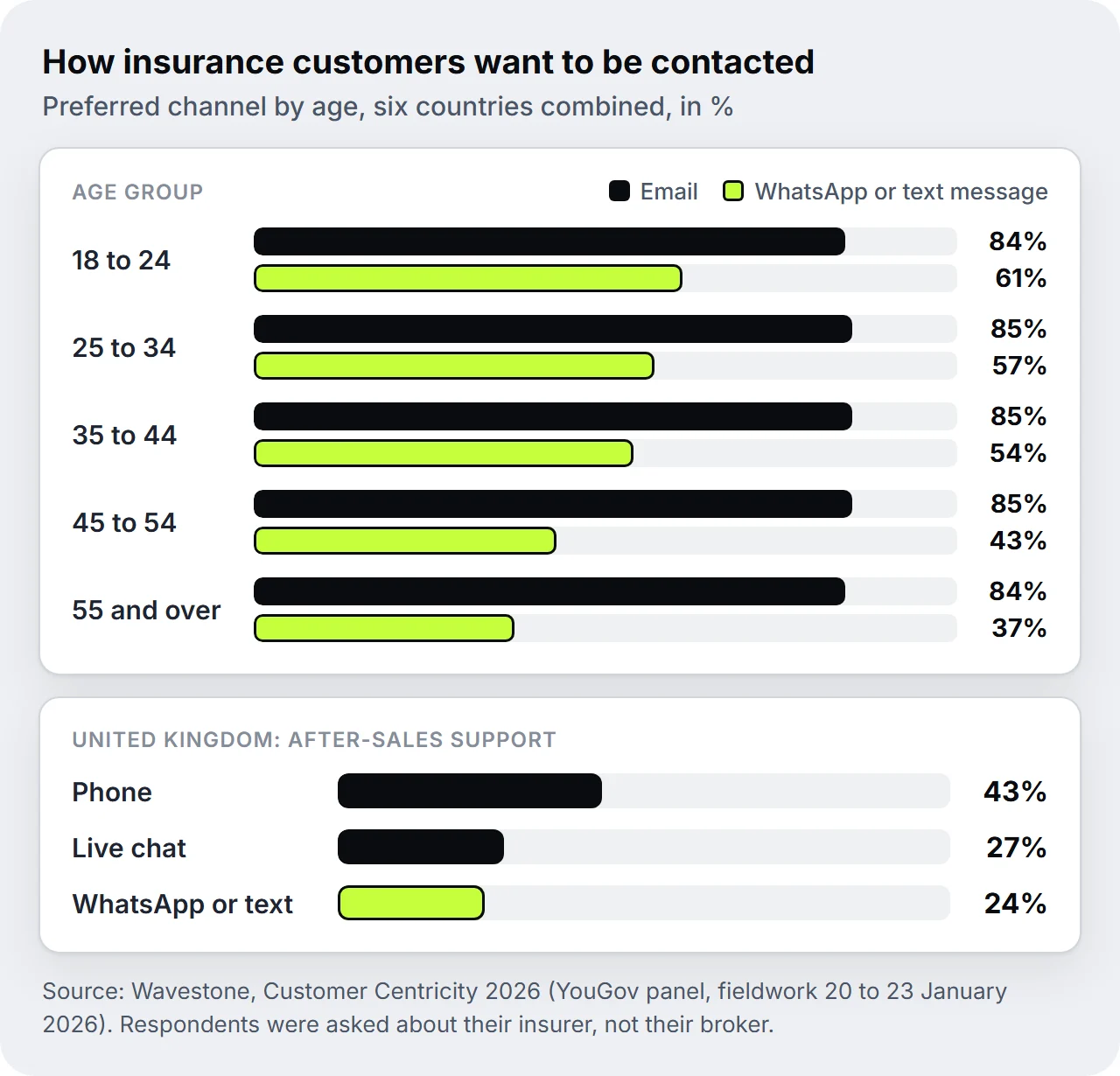
Mostly by email or phone, with messaging alongside. The most recent data comes from the Wavestone study "Customer Centricity 2026", a YouGov panel survey of 8,960 people in six countries, including the UK, carried out in January 2026. Email is the preferred channel of 84% to 85% of insurance customers in every age group. WhatsApp or text message is preferred by 61% of 18 to 24-year-olds, 57% of 25 to 34-year-olds, 54% of 35 to 44-year-olds, 43% of 45 to 54-year-olds and 37% of those aged 55 and over. Messaging complements email rather than replacing it, and it matters most for younger clients.
Two caveats. Wavestone asked about people's insurer, not their broker, so read the figures as a backdrop. And the UK profile for after-sales support from the insurer shows the phone clearly ahead: 43% of UK insurance customers prefer it, against 27% for live chat and 24% for WhatsApp or text message.
People are on WhatsApp whether or not a brokerage is. Ofcom's Online Nation 2025 reports that 90% of UK adults online used WhatsApp in May 2025, and 74% used it daily (as reported by ISPreview on 10 December 2025). Messaging apps are where clients already talk to everyone else, and a photo of a dented bumper is easier to send than to describe on the phone.
We say this as a messaging provider: clients do not want WhatsApp. They want an answer when they have the question. For many, that is still the phone or email. So no channel replaces another. The phone stays, the meeting stays, and the channels clients already use come on top. What matters is that everything arrives in one place and someone replies. How this looks for brokers and intermediaries more broadly is on our industry page for insurance.
Why is being reachable your edge over the insurer?
Being reachable is your edge because a broker is a small team that clients know by name, and a quick, personal answer from someone who knows their policies is hard for a large insurer's service desk to match. Brokers carry real weight in the UK market: according to BIBA figures reported by Insurance Business on 14 July 2026, general insurance brokers arrange 77% of all UK general insurance and 94% of commercial insurance business. Clients already come to you.
We found no reliable UK figure on how quickly brokers or insurers answer messages, so we quote none. The argument is a plain one: a message waits, a phone call does not. A client who writes at 7:15am from the train gets a reply that says what happens next, and does not have to try again from the office at lunchtime.
How fast should a broker reply to a client message?
A broker should reply personally on the same working day, within a few hours during office hours, and outside office hours send a short acknowledgement straight away that says when somebody will be in touch. That is our recommendation: there is no standard, and we found no reliable UK survey of how fast clients expect a reply to a message. You can measure it as first response time. Reliability matters more than the minute: a client who knows to expect an answer by 10am does not ring three times.
How can a small brokerage stay reachable outside office hours?
A small brokerage stays reachable outside office hours by accepting messages on WhatsApp, email or live chat when nobody is in the office, saying honestly when someone will reply, and answering first thing. What arrives at 7:15am is at the top of the inbox at 8am. From the Professional plan, an away message replies automatically outside your office hours, and an AI agent can answer simple questions straight away (more in the section on AI). The rest waits for the team, with the history in front of them.
Which channel suits which request?
Appointments, documents, claim photos and status questions suit WhatsApp, email or live chat. Advice on cover belongs in a call or a meeting, and health details, full card, account and ID numbers belong in no chat at all. So the channel matters less than the request and the data involved. The table sorts the most common requests in a brokerage.
| Request | Suits well | What to watch |
|---|---|---|
| Arrange a call or callback | WhatsApp, SMS, email, live chat | Send the link to your existing online calendar |
| Send in a document | WhatsApp, email | A photo or PDF will do; confirm receipt briefly |
| Report a claim | WhatsApp, email, phone | Photos and a short description, then give status updates without being asked |
| Claim status and payout updates | Email, plus a short message in the chat | In the Wavestone study email is the preferred channel for this in every market, from 65% to 79% |
| Question about a renewal notice, premium or policy schedule | Any channel | Reply in the same channel the question came in |
| First contact via website or social media | Instagram, Messenger, live chat | Reply quickly, and offer a call for any advice |
| Advice on cover or a cover review | Phone or meeting | In the chat, only arrange the call; phone leads for advisory interactions in the UK at 43% |
| Health details, full card, account and ID numbers | Not in the chat | Link to the client portal or a secure upload |
In practice, clients write wherever they are: one on WhatsApp, another by email, a third through the live chat on your website. To keep that from turning into a search, every channel belongs in one shared inbox, a unified inbox. SendSeven is an AI-powered messaging platform. From the Basic plan at €49/month all eight channels are included, with unlimited users and no per-seat fee.
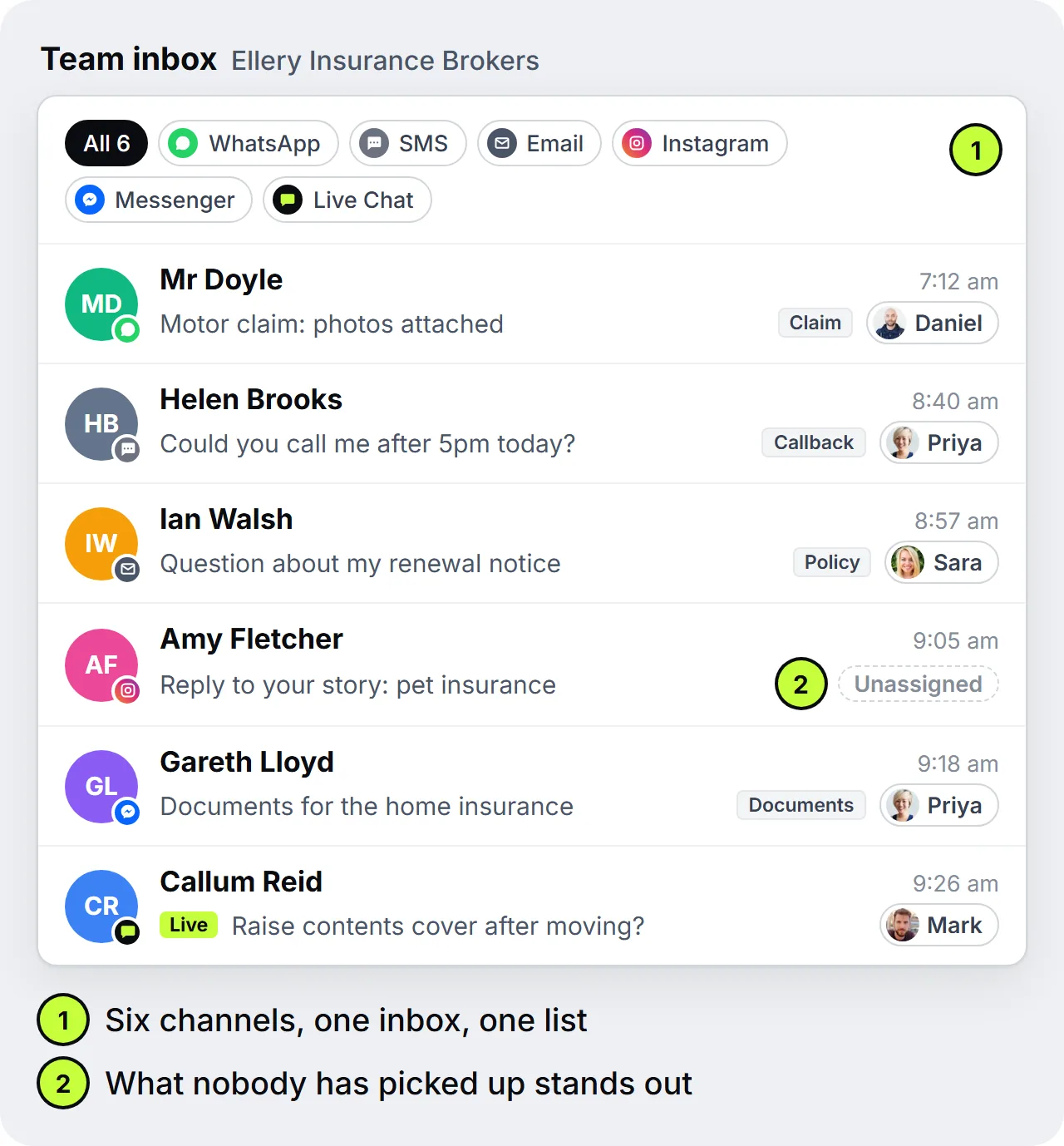
The whole team works in one shared inbox with tags and internal notes. From the Professional plan, SendSeven also distributes requests automatically and separates inboxes by team or location. How a team inbox works in detail is covered in WhatsApp Team Inbox: Manage Conversations with Multiple Agents.
From the WhatsApp Business app to a team inbox
In many brokerages WhatsApp has run for years through the WhatsApp Business app on the owner's phone. That works until the owner is on holiday or off sick, or the office manager cannot see what was promised to a client. With WhatsApp Coexistence, the Business app and the WhatsApp Business API run in parallel on the same number. Meta has supported Coexistence in the EEA, EU and UK since 23 October 2025. Daniel Ellery, who runs Ellery Insurance Brokers, keeps typing on his phone, Priya and the team reply from the inbox, and no client has to change anything.
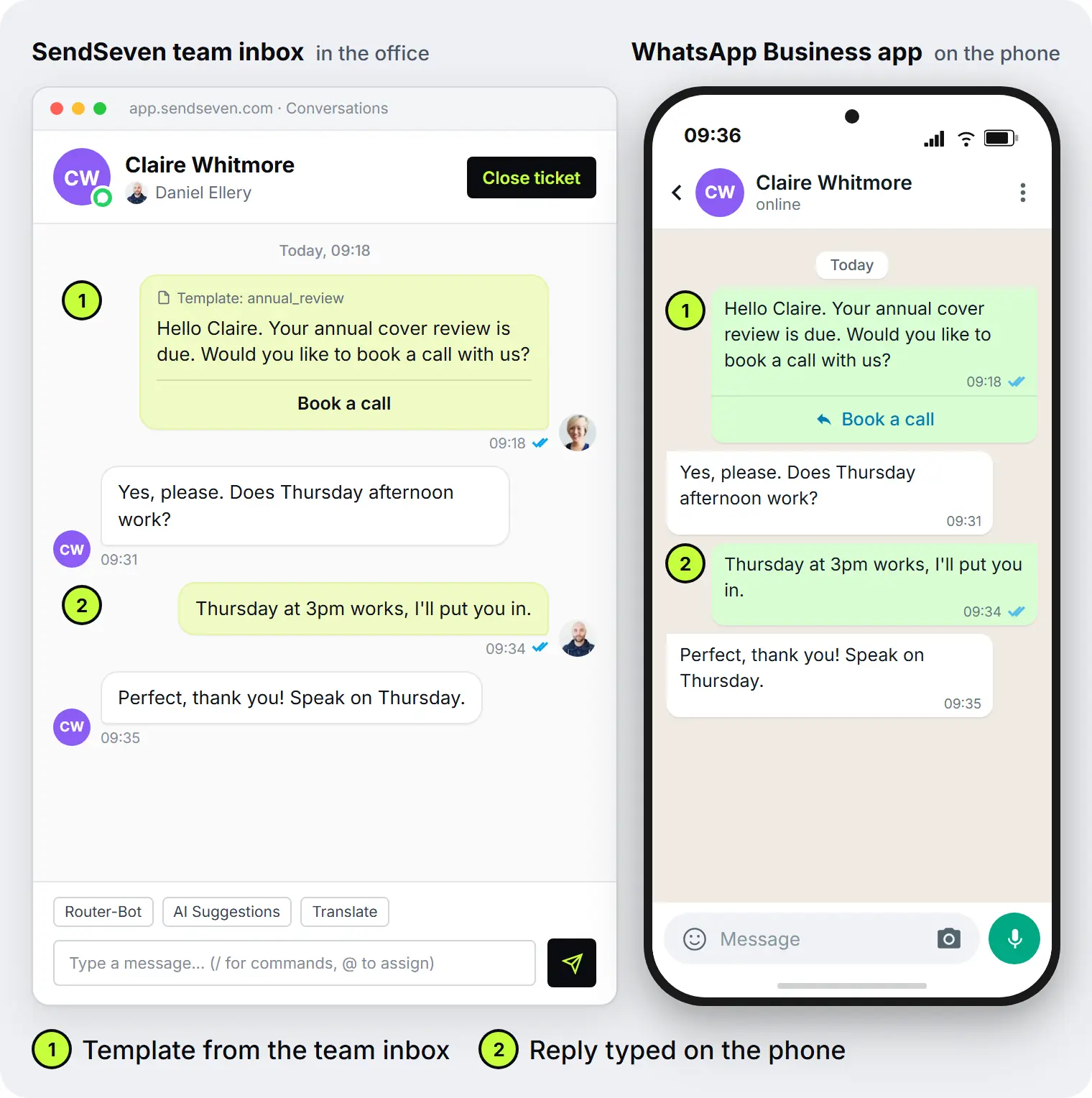
When you connect, your 1:1 chats from the last up to 180 days come into the inbox, and media from the last up to 14 days. Replies typed on the phone land in the inbox too, so the team sees them in the history. A few things stay in the app: groups do not come across, and the phone must be opened at least every 13 days to keep the connection alive. Coexistence is included in every SendSeven plan, Basic included.
Our article WhatsApp for insurance brokers: keep the app, bring in the team walks through it step by step, and the guide to WhatsApp Coexistence covers the technology behind it. What a team gains on top is on the page WhatsApp Business app with a team.
How does a claim notification via WhatsApp work?
The client sends photos and two sentences, the office confirms receipt, reports the claim to the insurer and then keeps the client up to date without being asked. That last step is the one clients notice. For claim status and payout updates, email is the preferred channel in all six markets of the Wavestone study, from 65% in Switzerland to 79% in the UK.
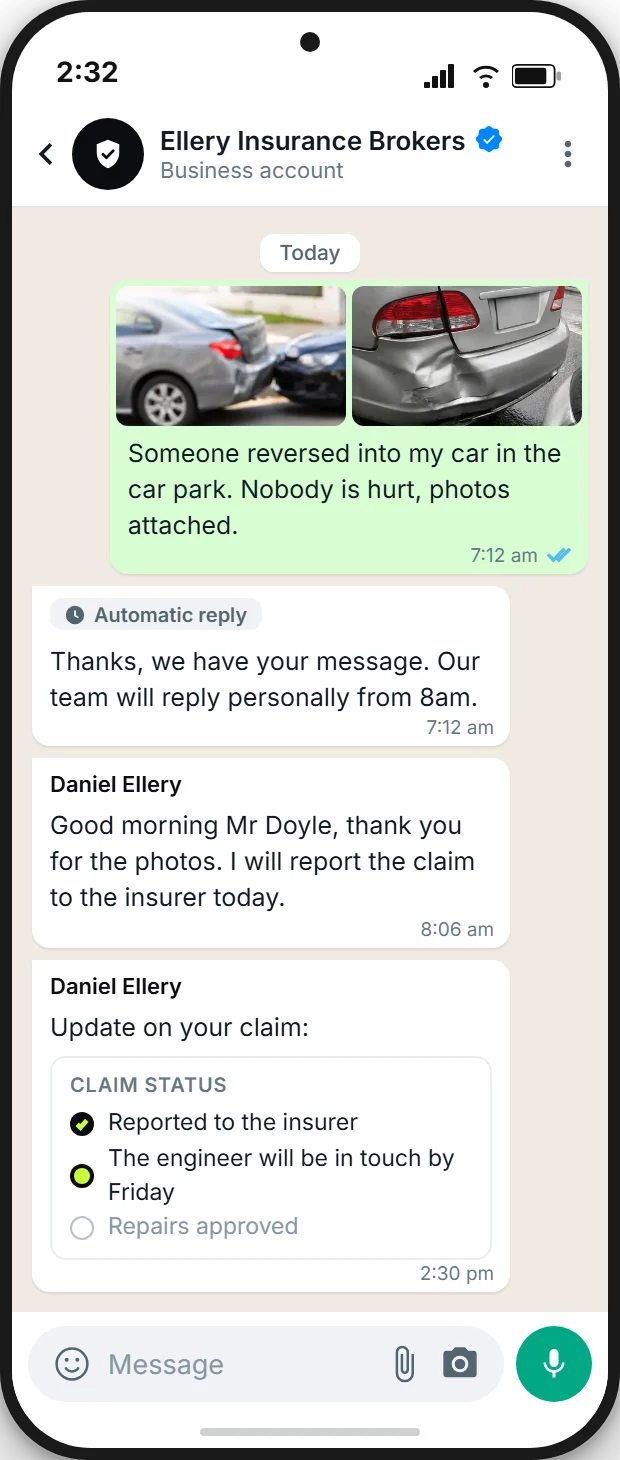
In the mockup, Mr Doyle writes at 7:12am: someone reversed into his car in a car park, photos attached. Because the office only opens at 8am, he gets an automatic acknowledgment that is marked as automatic. That automation comes with the Professional plan. At 8:06am Daniel Ellery replies personally and says he will report the claim to the insurer that day, and at 2:30pm the status follows.
One rule from Meta applies to the status. Within 24 hours of the client's last message, inside the 24-hour window, you can write freely, and Meta charges no fee for the first 1,000 such service messages per number per month (€0.0182 each after that). After the window you need a message template approved by Meta, such as "Update on your claim: the engineer will be in touch by Friday". Sent as utility templates, 120 claim status updates cost 120 × €0.0182 = €2.18 in Meta fees. To take the status from another system, such as your broker management system, connect it through the REST API, webhooks, Make or n8n. There is no ready-made integration with claims or broker management systems.
For recurring reports with fixed questions, WhatsApp Flows (beta) fit: a short form inside the chat with fields for date, place and photos, which saves a long back-and-forth of questions. How a flow like that is built is explained in Recurring reports with photos: collect them with a WhatsApp Flow. With Coexistence, only static flows are possible.
One thing does not belong in the chat: a statement about whether a claim is covered. The insurer decides that after assessment, and you discuss it with the client by phone or in person.
Existing clients: annual reviews and renewals
Most messages in a brokerage are replies. The bigger lever is the messages you write yourself. That is client retention: an annual review, a call before renewal, a note when a client's life changes. Without it, you hear from clients only when they have a problem.
The UK has no single switching date. Motor and home policies renew on each policy's own anniversary, so plan by renewal month: a tag or field with the month lets you write in December to the clients whose policies renew in January. Since 1 January 2022, ICOBS 6B.2.1R says a renewal price for home and motor insurance can be no higher than the equivalent new business price. So a renewal conversation is less about haggling and more about whether the cover still fits.
Moving house, a new baby, a new business, a new job or a new car are good occasions too, and where cross-selling helps the client.
How do you invite existing clients to an annual review by message?
With a short, personal message to a selection of clients who have agreed to receive it, and a button to book the call. Without consent, no marketing: the ICO's guide to PECR says the rules on electronic mail marketing cover texts, picture messages and direct messages on social media, and Meta's WhatsApp Business Messaging Policy requires opt-in before a business messages someone first. You collect the opt-in in conversation, on a form on your website or in the chat. For email, double opt-in is the better route. Importing your client list from a CSV file does not replace consent. How to prove consent later is covered in WhatsApp records for insurance brokers: chats and consent on file.
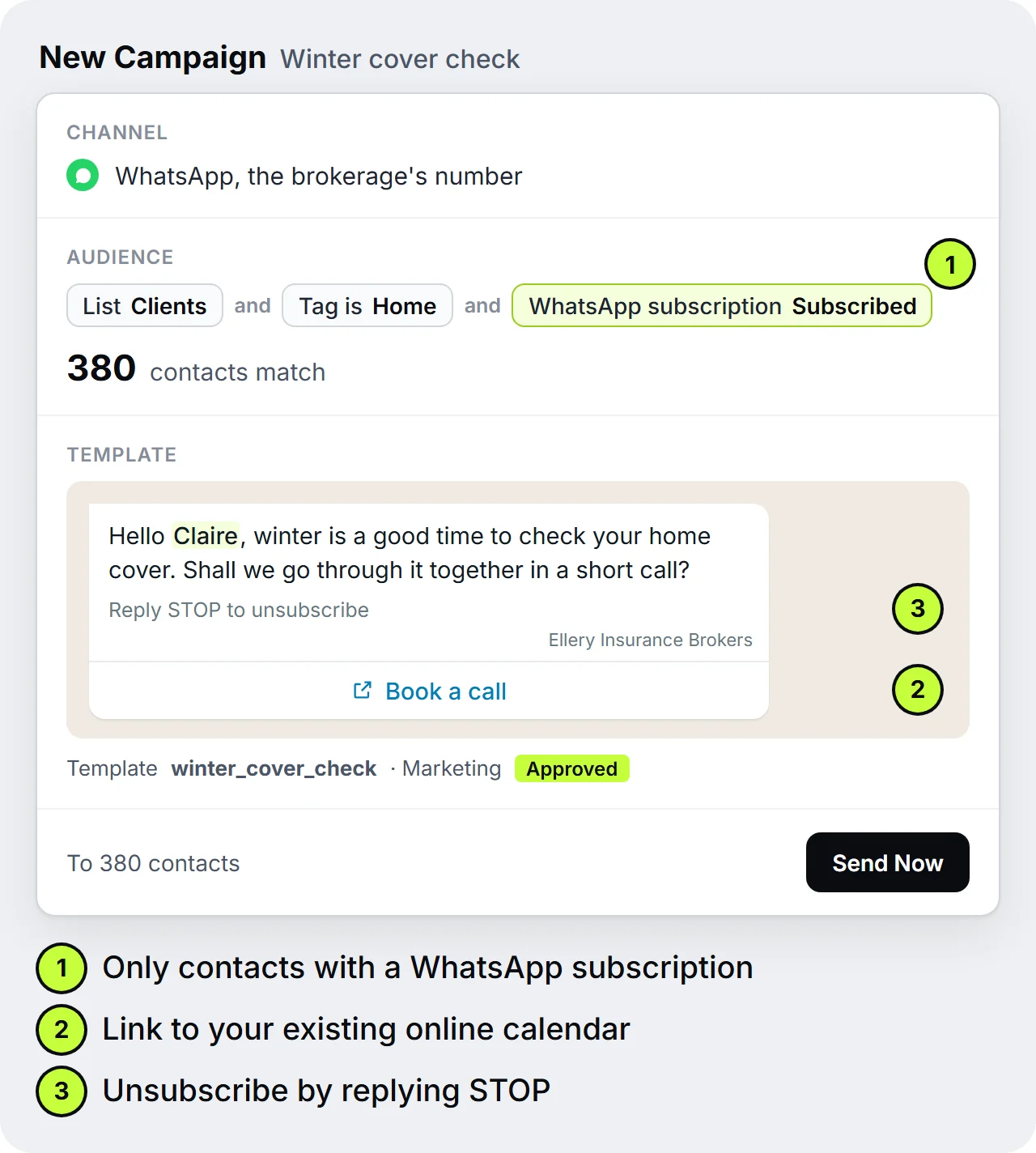
In SendSeven you build the audience from fields, tags and lists, in the example all clients on the Clients list tagged Home who have a WhatsApp subscription. This segmentation and sending campaigns are included from the Basic plan, and scheduling a send for later comes with the Professional plan. The "Book a call" button links to your existing online calendar. If a client replies STOP, SendSeven unsubscribes them automatically and they receive no more marketing.
Messages like this are marketing templates at Meta and cost per message. Since 1 October 2026 Meta charges for outbound messages sent from SendSeven, except the first 1,000 service messages per number per month. Incoming messages carry no Meta fee. At the UK rate of €0.0526 per marketing message in Meta's euro rate card, the winter cover check to 380 clients costs 380 × €0.0526 = €19.99 in Meta fees. SendSeven's own message fee applies on top: every outbound message counts against the 2,500 messages included in Basic and Professional, and beyond that it costs €0.02 per message. Meta bills its fees directly, not on the SendSeven invoice. The prices in detail are in WhatsApp Pricing 2026: What Meta Has Changed and What Stays the Same. How to gain subscribers without annoying clients is covered in WhatsApp Opt-in: 7 Strategies to Grow Subscribers in 2026.
Where does AI help a brokerage, and where doesn't it?
AI helps with the first answer, not with advice. An AI agent can explain in the evening what to report when moving house, how a claim is made or when the office is staffed again. It does not say whether a policy suits a client or whether a claim is covered. That stays with the broker, and that is how you should set the agent up. Which tasks an AI agent can take on in a brokerage, and how to start in 14 days, is covered in AI for insurance brokers: faster replies, advice stays with you.
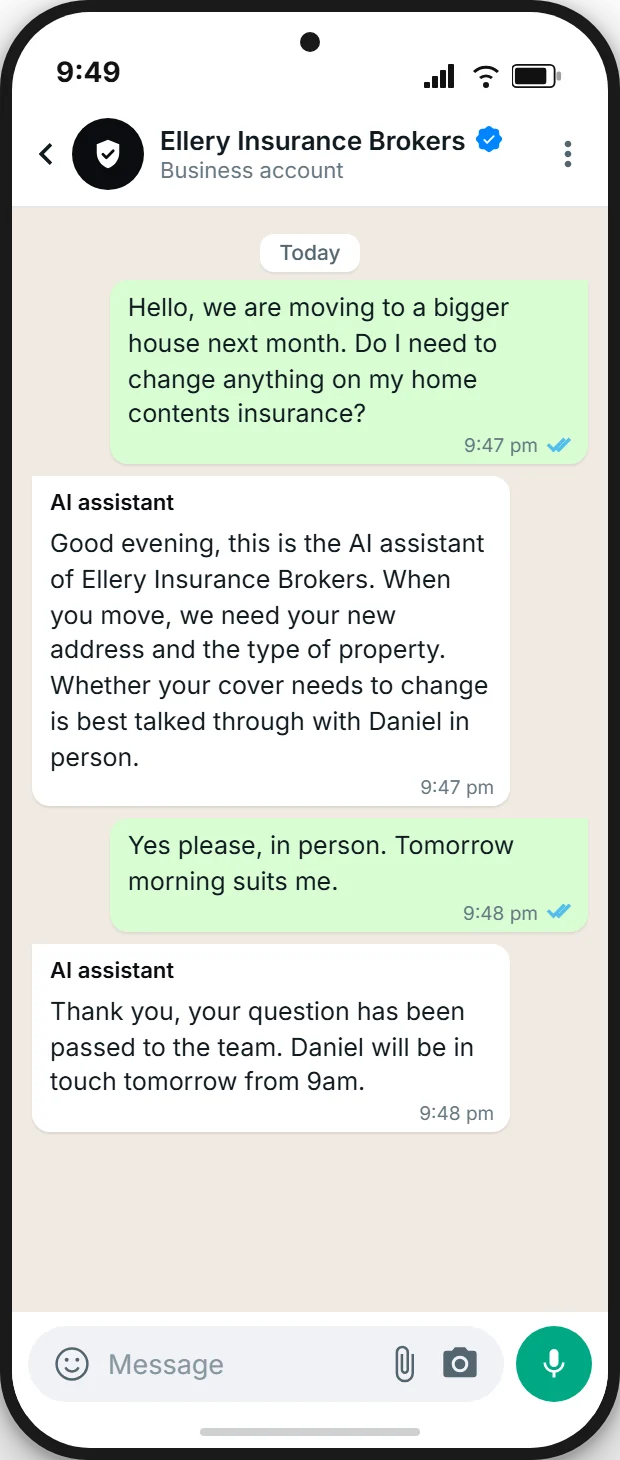
In the example, a question arrives at 9:47pm: does anything change on the home contents insurance when moving? The AI agent introduces itself as the brokerage's AI assistant and asks for the new address and the type of property. When the client asks to talk to Daniel in person, it hands the conversation over to the team.
Clients want that openness. In the Wavestone study, 92% of insurance customers across the six countries want to know whether they are talking to a person or an AI, and in every country more than 89% want to be handed over to a person quickly. In the UK profile the figures are 96% and 93%. If your firm also serves clients in the EU, the transparency duty in Article 50 of the EU AI Act may apply since 2 August 2026. The glossary entry on the AI transparency obligation and our article EU AI Act: Do You Have to Label Your Chatbot? (Since 2 August 2026) explain it.
At SendSeven the AI agent comes with the Professional plan at €79/month. AI use is counted in AI Credits, €0.01 per credit beyond what the plan includes. The agent answers from a knowledge base that you fill yourself, with opening hours, processes and checklists, and it says it is AI. When an AI chatbot fits and when a person in live chat does, the article Live Chat or Chatbot? Getting the Human and AI Mix Right compares, and the page on AI agents has the details.
Data protection and FCA rules: what you check yourself
A brokerage handles personal data, often sensitive data. For messaging that means a provider that signs a data processing agreement (DPA), and clear rules in the team about what belongs in the chat. SendSeven is GDPR-compliant, is hosted in the EU (Frankfurt) and transfers and stores data encrypted. Opt-ins and chat histories are documented with date and time, and you can export conversations as PDF or ZIP, by hand or automatically when a conversation closes. Meta processes WhatsApp, Instagram and Messenger data itself, including outside the EU and UK. No tool makes a firm compliant by itself, so the points below are for you to check.
Which client data doesn't belong in a messenger?
Health details, full card, account and ID numbers, and passwords. Health data is special category data under UK GDPR Article 9, and it comes up constantly in income protection, life and private medical insurance. Meta's WhatsApp Business Messaging Policy also prohibits asking clients for full card, account or ID numbers. For such details, send a link in the chat to your client portal or a secure upload.
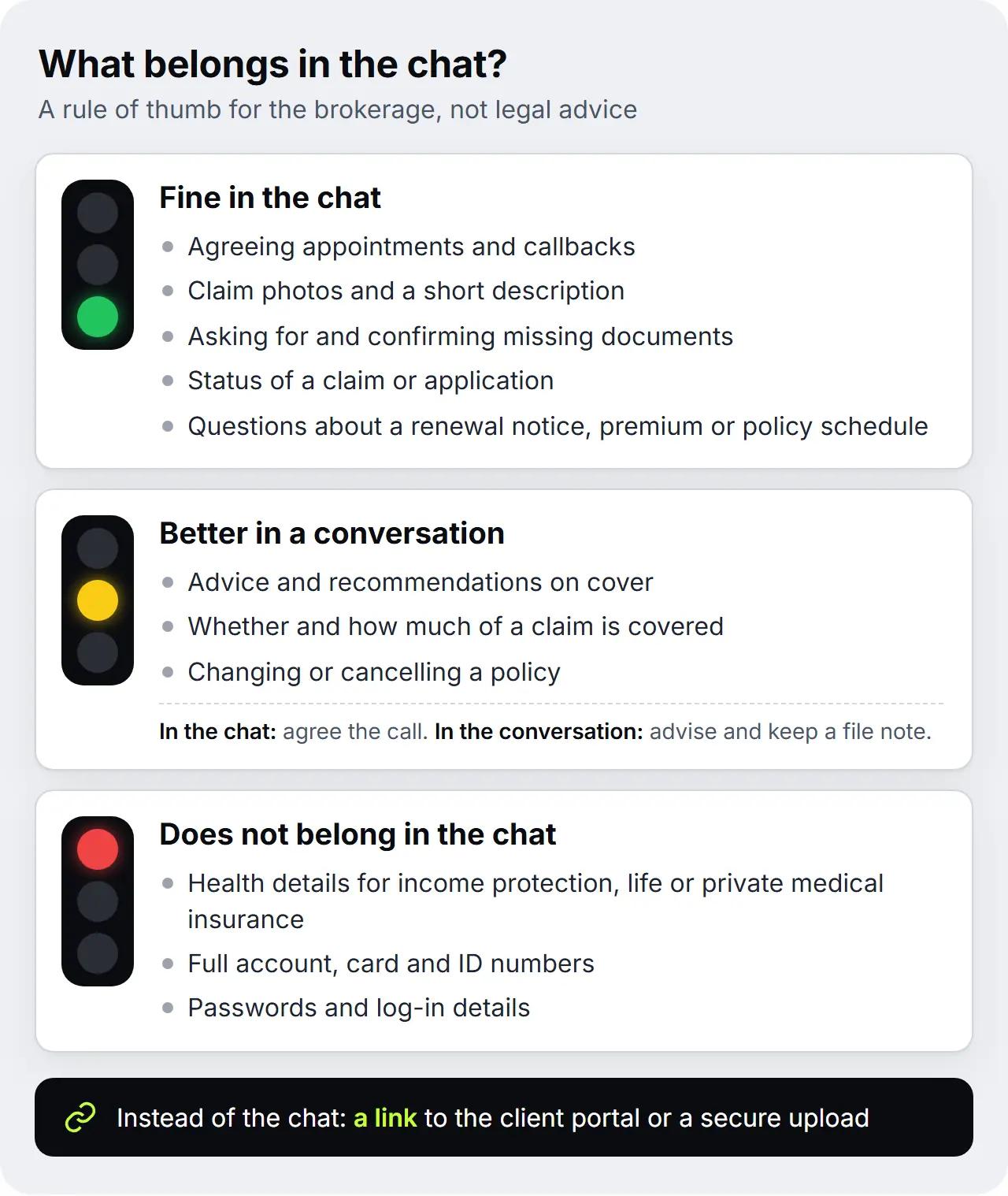
UK GDPR. Special category data such as health data needs particular care, and the ICO's guidance What is special category data? is the place to start.
PECR. A soft opt-in exists for marketing similar products to existing customers, with an opt-out in every message. Meta's policy still requires opt-in before a business messages someone first, so we recommend an explicit WhatsApp opt-in. UK GDPR Article 7(1) says a controller must be able to demonstrate that the person has consented, and the ICO's consent guidance lists what to record: who consented, when, what they were told, how, and whether and when they withdrew. In SendSeven a consent is a subscription per list and channel, with date and source.
ICOBS 5.2. ICOBS 5.2.2R says that before a contract of insurance is concluded, the firm specifies the client's demands and needs on the basis of information obtained from the client, and that the client receives a statement of them before the contract is concluded. A chat history can help trace what was said, but the advice itself is better held in a conversation and recorded in a file note.
SYSC 9. SYSC 9.1.1R says orderly records are to be kept of a firm's business and internal organisation. For how long, and in what form, is a question for your compliance consultant. How WhatsApp chats reach the client file next to the demands and needs statement is shown in WhatsApp records for insurance brokers: chats and consent on file.
This is general information, not legal advice. Check the details with your compliance consultant or data protection lead. More in the glossary entry on GDPR and business messaging.
Organise client communication in 30 days
A brokerage does not need a project to start, only four weeks with clear steps. The plan assumes clients already write to you by WhatsApp, email and phone.
- 1Week 1 · Take stockNote where clients write to you today, and set a reply target, for example the same working day. Agree as a team what belongs in the chat and what does not.
- 2Week 1 · Create an account and connectTry SendSeven free for 14 days. Connect your WhatsApp number with Coexistence, plus email and the live chat on your website. Request the DPA.
- 3Week 2 · Set up the teamInvite the team, create tags such as Claim, Documents and Callback, and set your office hours. From the Professional plan, an away message replies outside them.
- 4Week 3 · Templates and consentsSubmit templates for claim status and call invitations to Meta. Add the consent question to your forms and file notes.
- 5Week 4 · First campaignMessage existing clients who have opted in, for example about a winter cover check or an annual review, with a button to your calendar. Then count replies and booked calls.
FAQ
What is the difference between the WhatsApp Business app, Coexistence and the API?
The WhatsApp Business app runs on a single phone, the WhatsApp Business API connects the number to a platform for a whole team, and Coexistence runs both in parallel on the same number. Through the API with a platform such as SendSeven, the team replies together, uses templates and campaigns, and exports chat histories. With Coexistence the number also stays active in the app.
What do insurance brokers need to watch on WhatsApp?
A provider that signs a data processing agreement (SendSeven is hosted in the EU, in Frankfurt), consent before any marketing message, and a clear team rule that health details, account numbers and the advice itself stay out of the chat. Check the details with your compliance consultant.
What does WhatsApp cost a brokerage?
The WhatsApp Business app is free to download. A team inbox with SendSeven starts at €49/month on the Basic plan, which includes all eight channels, 2,500 messages and unlimited users. Automation and the AI agent come with the Professional plan at €79/month. Meta charges for outbound messages sent from SendSeven and bills those fees directly, while incoming messages and the first 1,000 service messages per number per month carry no Meta fee. Messages typed in the app are not billed by Meta, according to Meta. SendSeven's own message fee applies to every outbound message. More in WhatsApp Pricing 2026: What Meta Has Changed and What Stays the Same and the pricing overview.
Does a broker have to offer WhatsApp?
No. The phone still leads for after-sales support in the UK, at 43% in the Wavestone study. WhatsApp is worth it if your clients already write to you, or if you want to be reachable at the edges of the day without tying up the phone. Then organise it in the office, not on one phone.
Can a brokerage message all its clients on WhatsApp?
No. For marketing, such as an invitation to a winter cover check, you need the client's consent, and Meta requires opt-in before a business messages someone first. In SendSeven you filter the audience so that only contacts with a documented WhatsApp subscription receive the campaign.
How does a brokerage organise client communication as a team?
With one shared inbox for all channels, a fixed reply target and clear responsibilities. WhatsApp, email, SMS, live chat, Instagram and Messenger come together in one place, tags sort the requests, and internal notes record what was promised. If WhatsApp has so far run on the owner's phone, Coexistence connects the same number to the inbox.
Sources
- Wavestone: Customer Centricity 2026 (July 2026), YouGov panel, six countries, 8,960 respondents, fieldwork 20 to 23 January 2026, UK profile in annex A2. Respondents were asked about their insurer
- Ofcom: Online Nation 2025 (report, PDF), as reported by ISPreview on 10 December 2025
- BIBA figures, reported by Insurance Business on 14 July 2026
- Meta: Onboarding WhatsApp Business app users, developer documentation on Coexistence
- Meta: WhatsApp Business Platform changelog, Coexistence support in the EEA, EU and UK
- Meta: WhatsApp Business Messaging Policy
- FCA Handbook: ICOBS 5.2, ICOBS 6B.2 and SYSC 9.1
- ICO: Electronic mail marketing (PECR guide)
- ICO: How should we obtain, record and manage consent?
- ICO: What is special category data?
- European Commission: Guidelines on transparency obligations for providers and deployers of AI systems (for the EU hedge on Article 50 of the EU AI Act)
Further reading
- WhatsApp for insurance brokers: keep the app, bring in the team
- AI for insurance brokers: faster replies, advice stays with you
- WhatsApp records for insurance brokers: chats and consent on file
- WhatsApp Coexistence: Run the Business App and API in Parallel (2026 Guide)
- Recurring reports with photos: collect them with a WhatsApp Flow
- WhatsApp Business App vs API vs Coexistence: Which Setup Fits Your SMB? (2026)
- WhatsApp Team Inbox: Manage Conversations with Multiple Agents
- Client communication for insurance brokers and intermediaries